
Safe Gambling Tips Australia
Understanding What Safe Gambling Really Means
Safe gambling is not about finding a way to win consistently. It is about maintaining control over time, money, emotions, and expectations. For Australian players, safe gambling means treating gambling as entertainment rather than a source of income or a solution to financial problems.
Many people start gambling with the intention of having fun. Problems begin when gambling becomes connected to stress, boredom, frustration, loneliness, or money pressure. Once gambling starts serving an emotional purpose, it becomes more difficult to control.
Safe gambling practices help players avoid common risks before they become serious problems. These practices include budgeting, time management, self-awareness, regular breaks, and understanding how gambling products work.
For Stay Casino readers, responsible play begins before opening an account. It starts with setting limits and understanding that all gambling involves risk.
Set a Gambling Budget Before You Start
One of the most important safe gambling habits is setting a gambling budget. This budget should only include money that can be comfortably lost without affecting daily life.
Essential expenses such as rent, mortgage payments, food, transport, utilities, education, insurance, and savings should always come first. Gambling money should never come from funds needed for necessities.
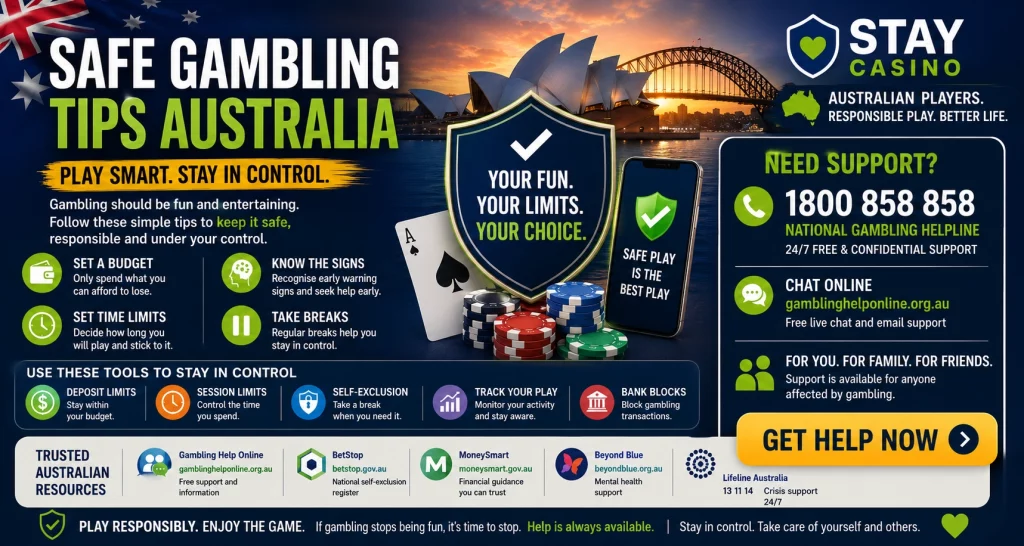
A gambling budget should be fixed before playing begins. Increasing the budget after losses creates a dangerous pattern that can quickly lead to financial harm.
Many Australian gambling support services recommend treating gambling spending the same way as entertainment spending. Once the allocated amount is gone, the session ends.
Use Time Limits Alongside Money Limits
Money limits are important, but time limits matter too. Long gambling sessions can reduce decision-making quality and increase impulsive behaviour.
Safe players decide how long they will gamble before starting. Once the time limit is reached, the session ends regardless of wins or losses.
Time limits help prevent gambling from taking over other important parts of life. They protect work responsibilities, family time, sleep quality, physical activity, and social relationships.
For players who frequently check the Login page multiple times each day, time management can be particularly valuable. Reducing access frequency often improves overall control.
| Safe Gambling Rule | Purpose | Benefit |
|---|---|---|
| Set a spending limit | Control financial risk | Prevents overspending |
| Set a time limit | Reduce prolonged sessions | Improves decision-making |
| Take regular breaks | Maintain perspective | Reduces impulsive behaviour |
| Track gambling activity | Increase awareness | Identifies risky patterns |
| Avoid chasing losses | Prevent escalating risk | Protects finances |
Never Chase Gambling Losses
Chasing losses is one of the most common unsafe gambling behaviours. It happens when a player continues gambling primarily to recover money already lost.
This approach is risky because emotional pressure often replaces logical decision-making. Bets become larger, sessions become longer, and losses can increase rapidly.
Safe gambling means accepting losses as part of the activity. Once money is lost, attempting to win it back immediately often creates greater harm.
Australian gambling support organizations consistently identify chasing losses as one of the strongest warning signs of gambling-related harm.
Understand Promotions and Bonuses Carefully
Promotions can be attractive, but they should never determine gambling decisions. A player should understand all terms and conditions before accepting any Bonus offer.
Safe gambling requires reading wagering requirements, eligibility conditions, withdrawal restrictions, and expiration rules carefully. Promotional offers do not eliminate risk.
Players should also avoid opening new accounts simply because a promotion appears attractive. A Sign up offer should never override responsible budgeting and limit setting.
The safest approach is to evaluate promotions objectively and remember that gambling outcomes remain uncertain regardless of bonuses.
Learn the Difference Between Entertainment and Income
A common gambling mistake is treating gambling as a way to earn money. Safe gambling requires understanding that gambling products are designed for entertainment.
No game guarantees profit. Short-term wins are possible, but long-term outcomes favour the operator. Players who understand this are less likely to make emotional decisions.
For Stay Casino readers, gambling should be viewed as a leisure activity similar to other forms of entertainment. It should not be part of a financial strategy or debt solution.
Recognise Early Warning Signs
The earlier a gambling problem is identified, the easier it becomes to manage. Warning signs often appear gradually.
Examples include spending more than planned, gambling for longer periods, thinking about gambling frequently, hiding activity from others, increasing deposits after losses, and neglecting responsibilities.
Players who notice these patterns should consider using responsible gambling tools, reducing activity, or contacting support services.
Recognising warning signs early is one of the most effective safe gambling strategies available.
Use Account Limits Before Problems Appear
Responsible gambling tools work best when they are used early. Many players wait until gambling becomes stressful before setting limits, but safer play starts before harm appears. Limits are not a punishment. They are a protective structure that keeps gambling within planned boundaries.
Account limits may include deposit limits, loss limits, session limits, cooling-off periods, and self-exclusion options. These tools help players stay aware of their behaviour and reduce the chance of impulsive decisions.
For Stay Casino readers, limit-setting should be treated as part of the normal playing routine. If a person cannot stay within limits, that is a warning sign that gambling may no longer be safe.
Delete Gambling Apps During High-Risk Periods
Mobile access makes gambling easier to start and harder to interrupt. A player may open an App during boredom, stress, public transport, lunch breaks, or late at night. This convenience can increase risk.
Deleting gambling apps during high-risk periods can reduce automatic behaviour. It creates a small barrier between the urge and the action. That barrier matters because gambling urges often fade if they are delayed.
Players who repeatedly reinstall gambling apps should consider stronger protections such as app blockers, device restrictions, bank gambling blocks, or self-exclusion.
Take Breaks During Every Session
Breaks help players maintain perspective. During long sessions, it becomes easier to lose track of time, money, and emotional state.
A safe gambling break should involve leaving the screen, checking spending, drinking water, moving around, and asking whether continuing still feels controlled. If the answer is uncertain, the session should end.
Breaks are especially important after a win or loss. Wins can create overconfidence, while losses can create chasing behaviour. Both states can increase risk.
| Responsible Gambling Tool | How It Works | When to Use It |
|---|---|---|
| Deposit limit | Restricts how much can be added to an account | Before the first session |
| Session reminder | Tracks time spent gambling | During every session |
| Cooling-off period | Temporarily blocks access | After emotional or risky play |
| Self-exclusion | Blocks gambling access for a longer period | When control feels difficult |
| Bank gambling block | Stops gambling-related transactions | When money access needs protection |
Avoid Gambling When Emotional
Safe gambling requires a clear mind. Players should avoid gambling when angry, anxious, lonely, bored, tired, stressed, or under the influence of alcohol.
Emotional gambling is risky because the person may use gambling to change how they feel. This can turn gambling into a coping mechanism rather than entertainment.
A safer approach is to create a personal rule: no gambling during emotional distress. If the urge appears during stress, the player should take a walk, contact someone, exercise, eat, rest, or use a support service.
Choose Games With Clear Rules
Players should understand rules, volatility, payout structure, and risk before playing any gambling product. Confusion increases the chance of poor decisions.
For example, different Slots may have different volatility levels. High-volatility games can produce longer losing periods, while lower-volatility games may create smaller but more frequent outcomes. Understanding this does not make gambling profitable, but it helps players recognise risk more clearly.
The same applies to table games, live casino products, and sports betting markets. Safe gambling requires knowledge before participation.
Track Time and Spending Honestly
Tracking gambling activity is one of the simplest ways to identify risk. A player may believe gambling is occasional, but records may show frequent deposits, long sessions, or repeated overspending.
A basic tracking habit can include date, time spent, amount deposited, amount lost or won, mood before gambling, and reason for playing. This information helps identify patterns.
If the tracking record creates discomfort, that is useful information. It may indicate gambling is becoming more harmful than expected.
Know When Safe Gambling Is No Longer Enough
Responsible gambling tools are helpful, but they are not always sufficient. If a player repeatedly breaks limits, hides gambling, borrows money, chases losses, or feels unable to stop, the safest step is to stop gambling completely and contact support.
Safe gambling becomes impossible when control is already lost. In that case, the priority should shift from “playing safely” to “stopping and getting help.”
Australian players can use the National Gambling Helpline, Gambling Help Online, BetStop, and local counselling services when gambling becomes harmful.
Understand Game Risk Before Playing
Safe gambling depends on understanding that every gambling product carries risk. A player should know the rules, payout structure, volatility, and possible loss pattern before participating. Guessing how a game works is not responsible play.
Different gambling products create different experiences. Some are fast and repetitive. Others are slower and require more decisions. Faster products can increase risk because players may make many decisions in a short period of time.
For Stay Casino readers, this means every session should begin with clear awareness. A player should not choose Games only because they look exciting, popular, or heavily promoted. The safer choice is to understand how the game works first and decide whether it fits the player’s budget, time limit, and emotional state.
Avoid Fast, Repetitive Play When Control Feels Weak
Fast gambling products can create strong emotional momentum. When outcomes happen quickly, players may continue without noticing how much time or money has been spent. This is especially risky after losses, because the urge to continue can appear automatically.
Players who feel tired, emotional, stressed, or distracted should avoid fast sessions. If gambling no longer feels calm and controlled, it is safer to stop immediately.
A responsible gambling session should feel slow enough for the player to think clearly. If decisions become automatic, the session has become unsafe.
| Safe Gambling Check | Question to Ask | Responsible Action |
|---|---|---|
| Game understanding | Do I know the rules and risks? | Read rules before playing |
| Budget control | Can I afford to lose this amount? | Stop if the answer is no |
| Time control | Have I set a session limit? | Use reminders or alarms |
| Emotional state | Am I gambling because of stress? | Take a break or contact support |
| Loss reaction | Am I trying to win money back? | End the session immediately |
Read Safer Gambling Information Before Problems Start
Many players only search for help after gambling has already become stressful. A safer approach is to read responsible gambling guidance before the first warning signs appear.
The FAQ section of a gambling site should not only be used for payments, bonuses, or account access. It should also be used to understand limits, self-exclusion, cooling-off periods, account closure, and support options.
If a site does not clearly explain safer gambling tools, players should treat that as a concern. Responsible platforms should make support information easy to find.
Use External Support Links, Not Only Casino Tools
Casino tools can help, but independent support services are often more important when gambling starts causing harm. Australian players should know where to find external support before they need it.
Useful Links include Gambling Help Online, BetStop, MoneySmart, Beyond Blue, Lifeline Australia, and state-based gambling support services. These resources provide confidential guidance outside the gambling environment.
A player who feels uncomfortable reading support information may already be noticing early signs of harm. That discomfort should be taken seriously.
Make Safe Gambling a Social Conversation
Gambling is easier to control when it is not hidden. Players who gamble should be able to talk openly about time spent, money spent, and limits used. If gambling becomes secretive, risk increases.
A simple conversation with a trusted person can help maintain perspective. This person does not need to control the player’s life. Their role may be only to ask honest questions and notice changes.
Social accountability is especially helpful during high-risk periods such as payday, sports events, holidays, or personal stress.
Use Australian Support Services Early
Australian players can access free and confidential gambling support. The National Gambling Helpline, Gambling Help Online, BetStop, and financial counselling services can all help depending on the situation.
Support should not be viewed as something only for severe cases. Early contact can prevent the problem from getting worse.
If gambling causes anxiety, debt, secrecy, repeated overspending, or relationship conflict, safe gambling tools may no longer be enough. In that situation, the safest choice is to stop and contact support.
Recognise When Entertainment Has Turned Into Pressure
Gambling should not feel like pressure. If a player feels they must continue, must recover losses, must hide behaviour, or must gamble to feel better, the activity is no longer safe entertainment.
This is the point where responsible gambling changes from limit-setting to stopping. The player should leave the session, block access, and use support.
Safe gambling is not only about how much money is spent. It is about whether the player remains free to stop.
Review Gambling Behaviour Every Month
Safe gambling is not a one-time decision. It requires regular review. A player may begin with strong limits, but habits can change over time. Monthly reviews help identify whether gambling remains controlled or is becoming risky.
The review should be honest and practical. The player should check how much money was spent, how much time was used, whether limits were followed, and whether gambling affected mood, sleep, work, family, or financial responsibilities.
If gambling spending has increased, if sessions have become longer, or if the player feels defensive about the results, this may indicate rising risk. In that case, stronger limits or a complete break may be necessary.
Build a Personal Safe Gambling Checklist
A checklist makes responsible gambling easier to follow. Before any session, the player should ask whether they are calm, sober, financially secure, and able to stop when the limit is reached.
If any answer is negative, the safest decision is not to gamble. This rule protects players from emotional, impulsive, or financially risky decisions.
Safe gambling works best when decisions are made before emotions become intense. A checklist gives structure and removes guesswork.
| Safe Gambling Checklist | Yes / No | Recommended Decision |
|---|---|---|
| Have I set a fixed spending limit? | Yes / No | Do not start without a limit |
| Have I set a fixed time limit? | Yes / No | Use an alarm or session reminder |
| Am I calm and not gambling from stress? | Yes / No | Pause if emotions are high |
| Can I afford to lose this money? | Yes / No | Do not gamble with essential funds |
| Will I stop after reaching my limit? | Yes / No | Stop immediately if control feels uncertain |
Use Breaks and Cooling-Off Periods Without Delay
A cooling-off period can be useful when gambling starts feeling too frequent or emotionally intense. It gives the player time away from the gambling environment and helps reset decision-making.
Players should not wait until serious harm occurs before taking a break. If gambling thoughts become persistent, if limits feel difficult to follow, or if losses create strong frustration, a cooling-off period is appropriate.
Longer self-exclusion may be necessary when the player repeatedly returns despite intending to stop.
Keep Gambling Separate From Financial Goals
Gambling should never be connected to financial goals. It should not be used to pay debt, create savings, cover bills, or solve short-term money pressure.
Safe gambling means accepting that money used for gambling may be lost. If losing that money would create stress, the session should not happen.
Financial goals should be built through budgeting, saving, work, education, and planning — not gambling outcomes.
Final Safe Gambling Advice for Stay Casino Readers
For Stay Casino readers in Australia, safe gambling begins with limits and ends with honesty. If gambling remains occasional, affordable, and controlled, responsible tools can help maintain safety. If gambling creates stress, secrecy, debt, repeated overspending, or emotional pressure, the safer decision is to stop and contact support.
Australian players have access to gambling support services, self-exclusion tools, financial counselling, and mental health resources. These options should be used early, not only after major harm occurs.
Safe gambling is not about proving control. It is about protecting money, health, relationships, and future stability. If gambling stops feeling safe, stepping away is the strongest decision.
When Responsible Gambling Becomes Stopping Gambling
The final safe gambling tip is to recognise the point where moderation is no longer enough. If a player cannot follow limits, cannot stop after losses, hides gambling, borrows money, or feels anxious without gambling, the safest option is not controlled play. The safest option is stopping.
Stopping may include account closure, self-exclusion, bank gambling blocks, counselling, and support from trusted people. These steps are protective, not extreme.
Safe gambling is successful only when the player remains in control. Once gambling begins controlling money, time, mood, or behaviour, support should come first.






Comments