
Stay Casino Legality
What “Legality” Means for Stay Casino Readers
Legality is one of the most important safety questions in Australian online gambling discussions. A website can look professional, advertise large rewards, show casino-style graphics, and accept visitors from Australia, but that does not automatically mean the service is lawful, safe, or protected for Australian users.
For Stay Casino readers, legality should be understood as a protective filter. Before anyone shares personal information, creates an account, downloads an app, reads promotional terms, or sends money, the legal status of the service must be questioned. A lawful and accountable environment should clearly explain who operates it, which rules apply, what protections exist, how complaints are handled, and what responsible gambling tools are available.
ACMA states that the Interactive Gambling Act 2001 makes it illegal for gambling providers to offer some online services to people in Australia, and banned services include online casino-style gambling products. This is a central point: a casino-style website being visible online does not prove that it is legal for Australian users.
Access Is Not the Same as Legal Permission
One of the biggest misunderstandings is assuming that if a gambling website opens in a browser, it must be allowed. That assumption is unsafe. Offshore websites, mirror domains, social media promotions, and search ads can still reach Australian users even when the service creates legal or consumer-protection risk.
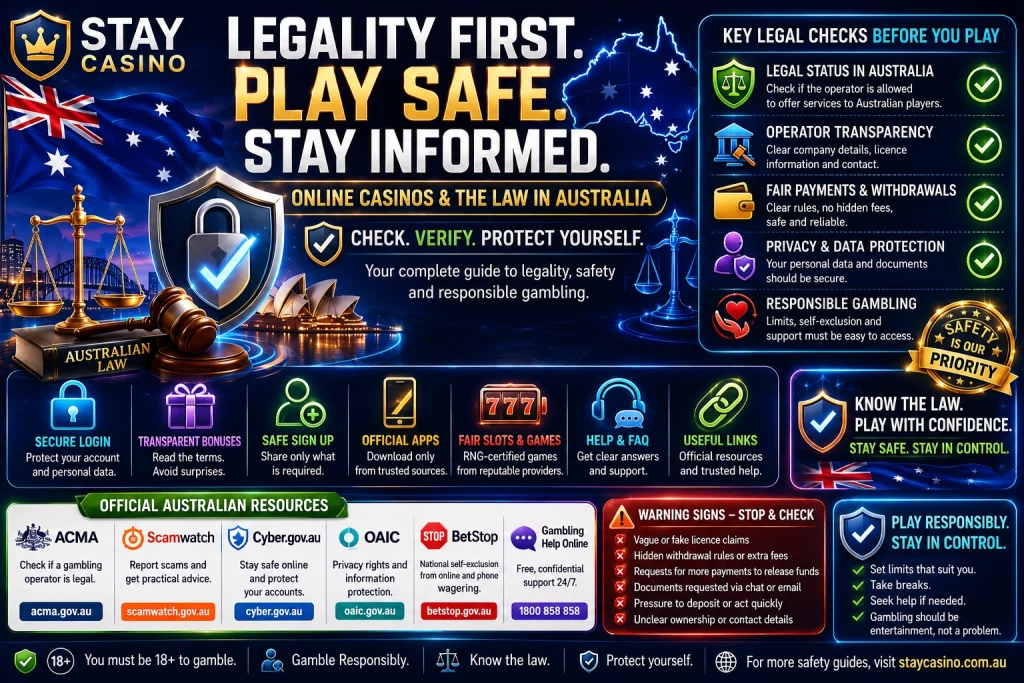
ACMA provides a tool for checking whether a gambling operator is legal and says that a provider must be on the register of licensed interactive gambling providers to operate in Australia. If a gambling provider is not on the register, users should treat that as a serious warning sign rather than relying on the website’s own claims.
This is why legal review should come before design review. A clean interface, fast-loading pages, polished customer support chat, or attractive promotional language cannot replace official verification.
Why Login Safety Depends on Legal Clarity
The Login page is not only a technical feature. It is also a trust point. A user who enters credentials on an unclear or unlawful platform may expose an email address, password, device details, and account history to an operator with limited accountability.
A safer legal review asks several questions before any login action. Who operates the website? Is the operator named clearly? Are the terms consistent with the footer? Does the privacy policy identify the same company? Is the service legally permitted for Australian users? Are account closure and complaint processes explained?
If these answers are missing, users should not enter account credentials. Legal uncertainty and account-security risk often appear together.
Bonus Claims and Legal Risk
The Bonus section can create false confidence. Large promotional claims may make a website appear active, competitive, and legitimate. However, promotional strength does not prove legal status.
Unsafe or unlawful sites may use bonus offers to encourage quick registration before users check ownership, licensing, withdrawal terms, or privacy policies. A responsible legal review should treat promotions as a risk area, not as evidence of trust.
Users should be especially cautious when a promotion includes urgent language, unclear wagering rules, hidden withdrawal conditions, or “guaranteed” wording. If a website cannot first explain its legal status, its promotional offer should not be trusted.
Sign-Up Should Not Come Before Legal Review
The Sign up process may request personal data such as name, email address, phone number, date of birth, location, payment details, or identity documents. That data should not be shared before the legal status and operator identity are clear.
A safe legality page should warn users against registering with platforms that hide ownership or provide vague licence claims. Registration can create privacy, identity, marketing, and financial risk even before any gambling activity occurs.
| Legal Safety Area | What Users Should Check | Warning Sign |
|---|---|---|
| Australian legal status | Whether the provider is permitted to operate in Australia and appears on relevant official registers | The site claims to be “internationally licensed” but gives no verifiable Australian context |
| Operator identity | Company name, ownership details, jurisdiction, terms, privacy policy, and contact route | Different company names appear across the footer, terms, payment page, or support replies |
| Account access | Secure login, stable domain, HTTPS, and no suspicious redirects | Unexpected login links, copied branding, or browser warnings |
| Promotion terms | Bonus rules, withdrawal limits, expiry dates, and eligibility conditions shown before account action | Large offers with hidden rules or urgent pressure to deposit |
| Responsible gambling | Clear information about limits, self-exclusion, account closure, and support resources | Safety tools are hidden while promotional pages are prominent |
App Legality and Mobile Safety
A gambling-related App may create extra risk because it can request device permissions, store sessions, send push notifications, and connect with payment tools. Legal uncertainty becomes more serious on mobile because users may interact quickly without reviewing the full terms.
A user should not install an app from direct file links, social media messages, mirror pages, or unofficial download prompts. A legal and safety review should happen before installation, not after.
If the app does not clearly match the operator identity, privacy policy, and legal disclosures shown on the website, users should avoid it.
Casino-Style Games and Australian Restrictions
Pages promoting Slots or other casino-style Games should be reviewed with particular caution in Australia. ACMA’s guidance on the Interactive Gambling Act is important because online casino-style services are among the areas where legal restrictions are especially strict.
Game graphics, demo layouts, jackpots, provider names, and “fair play” labels do not prove legality. A platform may imitate legitimate entertainment design while still lacking legal permission or consumer protection.
For safety-focused content, the correct approach is not to encourage participation. The correct approach is to verify legal status, avoid unclear services, and use official resources when a site appears suspicious.
FAQ and Resource Links Should Support Safety
A serious legal FAQ should answer practical questions about Australian gambling law, operator status, payment risk, account closure, privacy, complaints, and gambling harm support. If a FAQ only explains deposits, promotions, and access, it is not enough.
Useful Links should point to recognised public resources, not only commercial pages. ACMA provides legal-status guidance and information about blocked gambling websites, while BetStop provides national self-exclusion from licensed Australian online and phone wagering providers. Once registered with BetStop, providers cannot let the person place bets, open new betting accounts, or receive marketing messages.
Why the Homepage Is Not Enough
A legality review should never stop at the homepage. Many gambling-related websites place their strongest marketing claims on the front page while hiding the important legal details in the footer, terms, privacy policy, payment pages, or support replies. A user who only looks at banners, promotions, or game previews may miss the information that actually determines risk.
For Stay Casino readers, the safest method is to review the entire account journey before taking any action. That means checking what the site says before registration, during account access, in the cashier area, inside bonus terms, on mobile pages, in support channels, and in responsible gambling sections.
A legally transparent website should stay consistent across all these areas. The same operator name should appear in the footer, terms and conditions, privacy policy, payment explanation, complaints policy, and support responses. If the site gives different company names or unclear legal wording in different places, users should treat that as a warning sign.
Checking the Operator Name
The operator name is one of the simplest legal checks. A website should clearly state which company operates the service. That company name should not be hidden behind vague claims such as “trusted global operator,” “licensed gaming provider,” or “international casino group.”
Users should compare the company name across the footer, terms, privacy policy, and payment pages. If the legal documents do not match the visible brand, the site may be poorly managed or intentionally misleading.
A legal review should also check whether the operator provides a practical contact route. A contact form alone is weaker than clear company details, support procedures, and complaint escalation steps. If the platform does not explain who is responsible for user disputes, accountability is limited.
Understanding Licence Wording
Licence wording can be confusing. Some sites use broad statements that sound official but are difficult to verify. Phrases such as “regulated worldwide,” “certified international casino,” or “licensed offshore” do not explain whether the service is lawful for Australian users.
A safer legal review asks specific questions. Which company holds the licence? Which regulator issued it? Which products are covered? Does the licence apply to Australian users? Can the licence claim be checked through an official source?
A licence for one type of gambling product does not automatically mean every casino-style feature is legally covered. Users should be cautious when a platform mixes wagering language, casino-style games, promotional offers, and unclear jurisdiction claims.
| Legal Review Point | What to Look For | Why It Matters |
|---|---|---|
| Operator consistency | The same company name appears across the footer, terms, privacy policy, and support replies | Consistent ownership makes accountability clearer |
| Licence specificity | The site names the licence holder, regulator, licence type, and product coverage | Vague licence wording may hide legal uncertainty |
| Australian relevance | The site explains whether and how the service is permitted for users in Australia | General offshore claims do not prove Australian legality |
| Complaint process | Users can find clear dispute steps before registration or payment | Legal uncertainty becomes worse when complaints have no path |
| Responsible gambling access | Limits, exclusion information, account closure, and support resources are visible | Player protection is part of a safer operating environment |
Payment Terms and Legal Accountability
Payment terms are closely connected to legal accountability. A website that cannot clearly explain deposits, withdrawals, fees, verification rules, and complaint routes should not be trusted with money.
A legal page should warn users that payment access does not prove compliance. Some unsafe sites can still process deposits through third-party providers, crypto wallets, manual transfers, or unclear payment routes. The ability to accept funds is not the same as being legally authorised or consumer-protected.
Users should review withdrawal conditions before any payment. If the withdrawal policy is vague, if extra fees are required to release funds, or if the site can change rules without explanation, the platform should be avoided.
Verification and Identity Documents
Legal uncertainty becomes more serious when identity documents are requested. A user should not upload a passport, driver licence, bank statement, or utility bill unless the operator is clearly identified, the legal status is understandable, and the privacy policy explains document handling.
A safer site should explain why identity checks are required, what files may be requested, how they are uploaded, how long review may take, who can access them, and how they are stored.
If documents are requested through social media messages, informal chat, unknown email addresses, or third-party links that do not match the operator, users should stop immediately.
Legal Risk and User Data
A gambling-related website may collect sensitive data even before a person deposits. Registration forms, login systems, app permissions, device tracking, marketing consent, and support messages can all create privacy exposure.
Legal review should include privacy review because accountability depends on knowing who controls user data. A privacy policy should identify the data controller, explain what information is collected, describe third-party sharing, and provide a contact route for privacy questions.
If a platform’s legal status is unclear and its privacy policy is vague, the risk is doubled. The user may not know who operates the site or who controls their data.
Legal Confidence
Advertising and Promotional Claims
Legal review should also include advertising. Gambling-related advertising can create risk when it uses misleading claims, unrealistic rewards, fake urgency, or unclear conditions.
Users should be cautious with claims such as “guaranteed win,” “risk-free casino,” “instant cashout,” or “exclusive legal access” if the website does not provide clear legal proof. Strong promotional language is not a legal guarantee.
A safer platform should separate marketing from legal information. Terms should be easy to find and written clearly. If promotional pages are detailed but legal pages are empty or vague, users should treat that imbalance as a warning sign.
Responsible Gambling and Legal Standards
Responsible gambling tools are part of a safer legal environment. A platform that claims to operate responsibly should provide access to deposit limits, time limits, cooling-off periods, self-exclusion information, account closure, and support resources.
These tools should be visible before a user experiences harm. If a site makes deposits easy but makes limits difficult to find, that is not a strong safety signal.
For Australian users, responsible gambling context is especially important because legal status and harm prevention are connected. A website that avoids legal clarity may also provide weak user protection.
Why Legal Review Should Include Official Resources
A legality page should not rely only on a website’s own claims. A gambling-related platform may say that it is licensed, secure, responsible, or internationally recognised, but those statements should be checked against external resources whenever possible.
For Australian users, official resources are important because online gambling rules are specific and strict. A platform may be accessible from Australia while still creating legal, payment, privacy, or harm-related risk. This is why users should compare website claims with regulator information, scam reporting tools, self-exclusion resources, cyber safety guidance, and privacy information.
A safe review should separate three things: what the website claims, what official sources say, and what the user can verify independently. If those three layers do not align, the user should treat the site as risky.
Official and Authoritative Resources
| Resource | Purpose | Useful Link |
|---|---|---|
| ACMA | Check whether a gambling operator is legal in Australia and understand blocked illegal gambling websites | ACMA legal gambling operator check |
| ACMA blocked sites | Review information about illegal gambling websites blocked in Australia | ACMA blocked gambling websites |
| Scamwatch | Recognise scam patterns, report suspicious activity, and review scam-prevention guidance | Scamwatch |
| Cyber.gov.au | Learn about phishing, account protection, password safety, and online security | Australian Cyber Security Centre |
| OAIC | Understand privacy rights and how personal information should be handled | OAIC privacy guidance |
| BetStop | Use national self-exclusion from licensed Australian online and phone wagering providers | BetStop |
| Gambling Help Online | Access free and confidential gambling support and self-help resources | Gambling Help Online |
Privacy as a Legal Safety Issue
Legal status and privacy protection are closely connected. A gambling-related website may collect personal information before a user fully understands who operates the platform. This can include name, email address, phone number, date of birth, residential address, payment information, device data, marketing preferences, gambling activity, and identity documents.
A safer platform should explain who controls this data, why it is collected, how it is stored, who may receive it, how long it may be retained, and how users can raise privacy questions. If the privacy policy is vague, copied, incomplete, or inconsistent with the operator name, users should not share personal information.
Privacy risk becomes more serious when identity verification is involved. Documents such as passports, driver licences, bank statements, or utility bills should never be uploaded unless the operator is clearly identified and the upload process is secure.
Matching Legal Identity With Data Identity
A strong legal review compares the company named in the legal section with the company named in the privacy policy. These details should match. If the legal section names one operator, the privacy policy names another, and the payment page shows a third entity, the user cannot clearly know who is responsible.
This matters because disputes often depend on accountability. If payment fails, a withdrawal is delayed, or personal data is mishandled, the user needs to know which entity is responsible.
A platform that cannot maintain consistent identity across its own pages should not be trusted with sensitive data.
Identity Verification and Document Safety
Identity verification may be presented as a compliance step, but users should review how it is handled. A safer process should explain what documents may be required, why they are needed, how files are uploaded, how long review may take, and how documents are protected.
Warning signs include document requests through social media, personal messaging apps, temporary live chat, unknown email addresses, or links that do not match the website domain. Sensitive documents should not be sent casually.
Users should also be cautious when verification requirements keep changing. If the platform repeatedly asks for more documents without clear reasons, this may indicate weak processes or a delay tactic.
Complaints and Legal Accountability
A legal platform should provide a complaint process. Users should be able to find out how to raise issues about account access, payments, verification, privacy, bonus terms, responsible gambling tools, or support quality.
The complaint process should not rely only on live chat. Written complaint routes are important because users need records. A safer website explains response timeframes, escalation steps, and contact methods.
If there is no complaint page, no escalation process, or no clear company contact, legal accountability is weak. A platform that accepts deposits but does not explain complaints should not be considered safe.
Scam Warning Signs in Legal Pages
Unsafe websites often make legal pages look formal without providing real accountability. They may use long paragraphs, copied legal language, fake licence numbers, broken regulator links, or logos that do not lead anywhere.
Users should look for practical details, not just legal wording. A real legal section should answer simple questions: who operates the site, where the company is based, what rules apply, which products are covered, how users complain, and how accounts can be closed.
If the legal page sounds official but avoids these questions, it is not useful.
Responsible Gambling as a Legal Trust Signal
Responsible gambling tools are part of a safer legal environment. A platform that discusses legality but hides harm-prevention tools is not giving users a complete safety picture.
Users should look for deposit limits, time limits, cooling-off options, self-exclusion information, account closure, support contacts, and practical instructions for reducing access. These tools should be visible before account problems appear.
A legal page should not only explain what the operator can do. It should also explain how users can protect themselves.
Marketing Consent and Promotional Control
Legal review should also include marketing consent. Users should check whether the platform explains how promotional messages are sent, how consent is collected, and how users can unsubscribe.
This is especially important for gambling-related services because promotional messages can trigger impulsive activity. Users should be able to opt out of marketing clearly.
A site that continues sending messages after opt-out requests, exclusion requests, or account closure should be treated as unsafe from a user-protection perspective.
Reputation and Pattern-Based Review
External reviews can support a legal assessment, but they should not replace official checks. The most useful reviews are specific. They describe dates, payment timelines, verification requests, support replies, complaint attempts, and policy references.
Users should look for patterns rather than isolated opinions. Repeated complaints about delayed withdrawals, fake licence claims, unclear verification, ignored support, or hidden terms should be taken seriously.
A legally safer operator should show consistency over time. If complaints repeatedly describe the same unresolved issue, the platform may have structural problems.
Why the Final Legal Review Should Happen Before Any Action
A legal review should happen before a user creates an account, enters personal details, downloads an app, reads promotional terms as an offer, uploads identity documents, or makes any payment. Once data or money has been shared with an unclear gambling-related website, the user may face privacy risk, payment disputes, identity exposure, marketing pressure, or difficulty closing the account.
For Australian users, the key principle is simple: visibility does not prove legality. A website may load normally, advertise casino-style products, display trust icons, and offer customer support while still failing important legal and safety checks. Legal clarity should come from verifiable information, not from design quality or promotional confidence.
A responsible legality page should help users slow down. It should encourage evidence-based review, comparison with official resources, and early exit when ownership, licensing, privacy, payments, or responsible gambling protections are unclear.
Complete Legal Safety
| Final Legal Check | What Users Should Confirm | Stop If You See This |
|---|---|---|
| Australian legal context | The site clearly explains whether the service is permitted for Australian users and provides verifiable legal information | The site is accessible but gives only vague offshore claims or unclear licence wording |
| Operator identity | The same company name appears across the footer, terms, privacy policy, payment pages, and support replies | Different company names, copied legal text, anonymous ownership, or missing contact details |
| Product coverage | The legal information explains which gambling products are covered by any stated authorisation | A general licence claim is used to justify casino-style products without product-specific clarity |
| Payment and withdrawal terms | Deposits, withdrawals, fees, limits, verification, and dispute steps are visible before payment | Extra release fees, unclear withdrawal rules, changing verification demands, or pressure to deposit more |
| Privacy and responsible gambling | The site provides clear data handling rules, secure document upload, limits, self-exclusion, account closure, and support resources | Privacy wording is vague, documents are requested unsafely, or player-protection tools are hidden |
Legal Risk Changes Across the User Journey
When Legal Claims Should Not Be Trusted
Legal claims should not be trusted when they cannot be verified. Some unsafe websites use official-sounding language without giving practical proof. They may show licence badges that do not link to a regulator, list numbers that cannot be checked, or use generic statements such as “licensed internationally” without explaining what that means for Australian users.
A stronger legal page should answer direct questions. Who operates the website? Which company controls user data? Which regulator or legal framework is being referenced? Which products are covered? What happens if a user has a complaint? How can an account be closed? How can promotional messages be stopped?
If a website cannot answer these questions clearly, users should not continue. Legal uncertainty is not a minor issue. It affects account security, payments, privacy, withdrawal reliability, and complaint options.
Product Legality and Casino-Style Risk
Casino-style products need extra caution in Australia. Users should not assume that a site is legal because it uses familiar game names, professional graphics, jackpot displays, or provider logos. Game presentation does not prove legal permission.
A website may show casino-style games while avoiding clear explanation of Australian legal status. That creates a major risk because users may believe visual familiarity means legitimacy. It does not.
The safer approach is to check legal context before considering any product page. If the website cannot explain whether the service is permitted for Australian users, then casino-style product pages should be treated as unsafe marketing rather than reliable entertainment information.
Payment Legality and Withdrawal Protection
Payment terms are part of legal safety. A legally clearer operator should publish deposit and withdrawal rules before payment. Users should be able to review processing times, minimums, maximums, fees, payment ownership requirements, verification steps, bonus restrictions, and complaint procedures.
A site that hides withdrawal rules until after deposit activity creates avoidable risk. A site that asks for extra money to release funds should be treated as especially dangerous. Common warning phrases include release fee, tax clearance, verification fee, unlock payment, VIP upgrade, or security deposit.
Legal review should therefore include a payment review. If money can enter easily but withdrawal conditions are vague, the platform has not passed a basic safety test.
Privacy, Identity, and Document Control
Legal clarity also protects personal information. A gambling-related website may collect sensitive data through registration, verification, payment processing, support messages, device tracking, marketing consent, and account history.
Users should check whether the privacy policy identifies the same operator shown in the legal section. They should also check whether document upload is secure and whether the site explains storage, access, retention, and third-party sharing.
Identity documents should never be sent through social media, informal chat, unknown email addresses, or links that do not match the platform. If the legal identity of the operator is unclear, sharing documents is not safe.
Responsible Gambling as a Legal and Ethical Signal
Responsible gambling tools are not separate from legality. They show whether the platform treats user protection as part of its operating environment. A legal and safety-focused review should check for deposit limits, time reminders, cooling-off periods, self-exclusion information, account closure, support contacts, and marketing opt-out controls.
If these tools are missing or difficult to activate, the platform should not be considered user-protective. A site that makes deposits easy but harm-reduction tools hard to find is showing poor safety priorities.
Users should also remember that legal clarity does not remove gambling harm risk. Even a legally clearer platform can still create financial or behavioural harm if use becomes difficult to control. Support resources should be used early, not only after serious problems appear.
Advertising Claims and User Pressure
Legal risk often appears in advertising language. Unsafe platforms may use pressure tactics such as countdown timers, urgent registration messages, guaranteed reward claims, instant-profit wording, or promises of risk-free gambling.
These phrases should not be treated as normal marketing. They reduce careful review and can push users toward account creation before they have checked the legal status.
A safer website should give users time to read terms, review legal pages, compare official resources, and decide without pressure. Legal transparency and urgency do not usually belong together.
What to Do If a Site Fails the Legal Review
If a website fails the legal review, users should stop before creating an account or sending money. They should not test the platform “just to see,” because even registration can expose personal data.
If a user has already shared details, they should reduce risk immediately. This may include changing reused passwords, securing email accounts, reviewing bank or card activity, saving screenshots, contacting the payment provider, unsubscribing from marketing, and reporting suspicious activity through relevant official channels.
If identity documents were uploaded to an unclear platform, users should be alert for follow-up scams, phishing messages, account takeover attempts, and suspicious financial activity.
Final Answer: What Legality Means for Stay Casino
Legality for Stay Casino readers should mean more than a badge in the footer. It should mean verifiable operator identity, clear Australian legal context, product-specific transparency, safe account handling, published payment rules, responsible data protection, complaint pathways, and visible gambling harm-prevention tools.
A website is not legally trustworthy just because it opens in Australia, offers casino-style games, promotes bonuses, or uses professional design. Trust should be based on evidence that can be checked before registration, payment, document upload, or account use.
The final rule is practical: if legal status is unclear, stop. If operator identity does not match across pages, stop. If payment terms are vague, stop. If documents are requested unsafely, stop. If responsible gambling tools are hidden, stop. Legal uncertainty is enough reason not to continue.






Comments