
SSL Encryption Casinos Australia
Why SSL Encryption Matters for Australian Casino Sites
SSL encryption is one of the first technical signals players look for when judging whether an online casino-style website protects personal information. In simple terms, SSL helps secure the connection between a user’s browser and the website. Today, most secure websites technically use TLS, the modern successor to SSL, but the phrase “SSL encryption” is still widely used by players, reviewers, and casino safety pages.
For Australian users, encryption is important because gambling-related websites may collect highly sensitive information. This can include names, dates of birth, email addresses, phone numbers, payment details, login credentials, identity documents, transaction records, device data, and account activity. If this information is not protected properly, it may be exposed to account theft, fraud, phishing, unauthorised access, or privacy misuse.
However, SSL encryption is only one part of safety. A website can use HTTPS and still have weak privacy rules, unclear ownership, poor withdrawal practices, unsafe verification procedures, or weak responsible gambling systems. A secure connection is necessary, but it is not enough by itself.
Australian players should also understand the regulatory context. ACMA explains that the Interactive Gambling Act 2001 makes it illegal for providers to offer certain online gambling services to people in Australia, and ACMA also warns that illegal gambling operators can expose consumers to risks such as losing money and having fewer protections.
SSL, TLS, and HTTPS Explained Clearly
SSL stands for Secure Sockets Layer. TLS stands for Transport Layer Security. In modern web security, TLS is the current standard, but many people still say “SSL certificate” or “SSL encryption” because the older term remains common.
When a website uses HTTPS, the browser and server create an encrypted connection. This makes it much harder for outsiders to read data sent between the player and the website. For casino-related platforms, this is especially important on registration pages, payment pages, identity verification portals, account dashboards, support forms, and password reset pages.
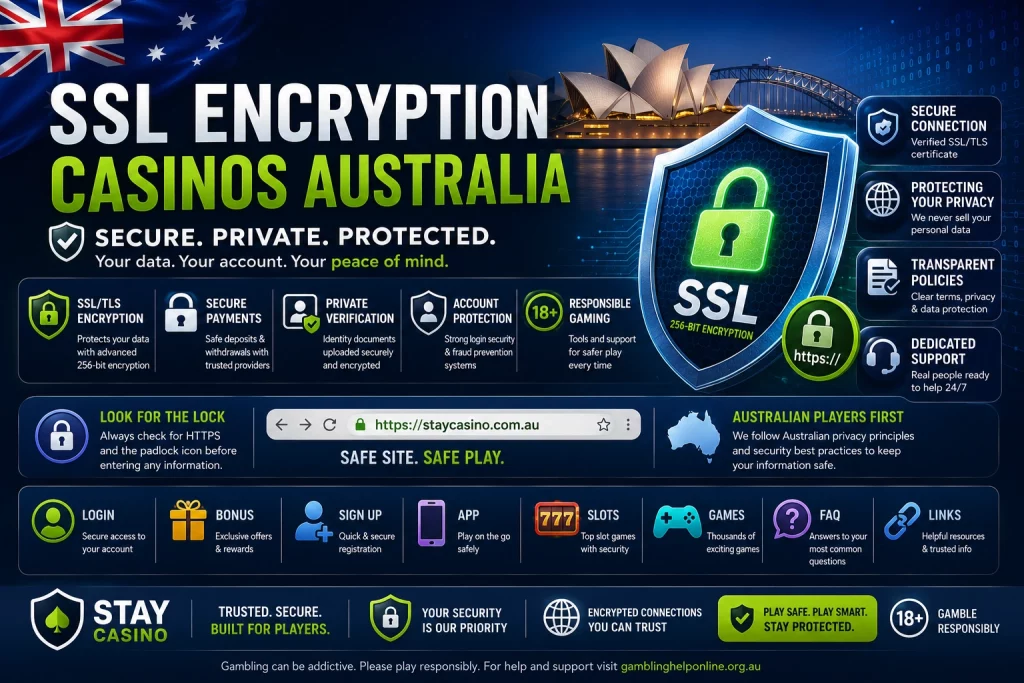
A secure website should show HTTPS in the browser address bar. Players should avoid entering personal details on pages that show browser security warnings, strange redirects, misspelled domains, or unsecured HTTP pages.
For Stay Casino readers, the safest mindset is simple: if the connection is not secure, do not enter personal or payment information.
Where SSL Encryption Should Be Used
SSL encryption should not appear only on the homepage. It should protect every sensitive part of the platform.
The Login page should be encrypted because it handles account credentials. A Bonus page should also be secure if it connects to account activity, promotional eligibility, or deposit actions. The Sign up process must be protected because it collects personal details and may begin identity verification.
Mobile safety matters too. If a gambling-related App connects to the same account system, it should use secure communication between the device and the server. Pages related to Slots and Games may not always collect identity data directly, but they still record session behaviour, account activity, and transaction-linked play history.
The FAQ section should clearly explain security, privacy, verification, payments, and responsible gambling tools. External Links should guide users toward recognised safety, privacy, regulatory, and support resources rather than only promotional pages.
Why Encryption Alone Does Not Prove a Casino Is Safe
A padlock icon does not automatically mean a gambling website is trustworthy. It only means the connection is encrypted. Unsafe operators can still use HTTPS. That is why players need to review other safety signals as well.
A safer platform should provide clear ownership information, privacy policy details, secure identity verification, transparent payment terms, responsible gambling controls, support contact options, and fair dispute procedures.
The Office of the Australian Information Commissioner explains that Australian Privacy Principle 11 requires covered entities to take reasonable steps to protect personal information from misuse, interference and loss, and from unauthorised access, modification or disclosure. This broader privacy obligation shows why encryption is only one layer of protection.
A gambling-related platform may encrypt traffic but still fail to protect stored documents, expose data through poor employee access controls, or use unclear third-party processors. Strong security requires layered protection.
| SSL / Security Area | What Safe Platforms Should Provide | Warning Sign |
|---|---|---|
| HTTPS connection | Secure encryption across login, registration, payments, verification, and account pages | HTTP pages, browser warnings, or suspicious redirects |
| Certificate validity | Valid certificate issued to the correct domain | Expired certificate or domain mismatch warning |
| Account protection | Strong passwords, secure reset process, optional two-factor authentication | Weak password rules or unsafe account recovery |
| Payment security | Encrypted payment pages and recognised payment processing controls | Unclear payment processor or unexpected payment redirects |
| Privacy compliance | Clear privacy policy explaining data collection, storage, sharing, and protection | Missing privacy policy or vague data handling terms |
SSL Encryption During Registration
Registration is one of the most sensitive moments in the user journey. A platform may ask for name, date of birth, address, email, phone number, username, password, and sometimes identity information. All of this should be transmitted through an encrypted connection.
Players should not complete registration if the page shows security warnings or if the domain looks suspicious. Phishing sites may imitate casino brands and collect personal data through fake registration forms. A secure connection helps, but domain accuracy is also important.
A safe registration process should also explain why information is needed. Age checks, identity checks, fraud prevention, and account security may be legitimate reasons for data collection, but the platform should make these reasons clear.
SSL Encryption During Payments
Payment pages require especially strong protection. Deposits, withdrawals, card details, e-wallet information, bank references, and transaction records should be handled securely.
Players should check whether payment pages remain on a trusted secure domain or redirect to a recognised payment processor. Suspicious payment redirections, unclear processor names, unusual payment requests, and missing transaction records should be treated carefully.
Encryption protects information during transmission, but payment safety also depends on internal controls, fraud monitoring, transaction logging, withdrawal transparency, and customer support quality.
SSL Encryption and Identity Verification
Identity verification may require sensitive documents such as a passport, driver licence, proof of address, bank statement, or payment ownership evidence. These documents should only be uploaded through secure portals.
Players should be cautious if support asks for documents through informal channels without clear security instructions. A safer platform explains document handling, storage, review timelines, and privacy protections.
Because identity documents can be misused if exposed, verification security is one of the strongest indicators of whether a platform takes data protection seriously.
First Conclusion on SSL Encryption Casinos Australia
SSL encryption is a basic requirement for any casino-related website that handles Australian player data. It helps protect information during transmission, supports safer account access, and reduces the risk of interception.
However, SSL is not a complete safety guarantee. Australian players should also check licensing context, legal status, privacy policy quality, payment security, responsible gambling tools, identity verification controls, and support reliability.
A secure connection is the starting point. Real safety requires a full system of technical, legal, privacy, and responsible gambling protections.
Secure Deposits and Withdrawals
Payment safety is one of the most important reasons SSL encryption matters for casino-related websites. When a player enters payment information, the data may include card details, bank references, e-wallet identifiers, transaction values, billing information, and account ownership records. This information must be protected during every step of the payment process.
A secure platform should use encrypted connections on deposit pages, withdrawal forms, payment confirmation screens, cashier sections, and account transaction history pages. If a payment page does not use HTTPS or redirects to an unfamiliar domain without explanation, the player should stop immediately.
SSL encryption helps protect information while it travels between the player, the platform, and payment systems. However, safe payments also depend on secure storage, verified processors, fraud checks, transparent transaction logs, and clear withdrawal rules.
Players should not rely only on a secure-looking page. They should also check whether the payment section explains fees, timeframes, limits, verification rules, rejected withdrawal reasons, and support contact options.
Why Payment Encryption Is Not Enough Alone
Encryption protects data in transit, but it does not guarantee that the operator handles payments fairly. A platform may use HTTPS and still create problems through unclear withdrawal terms, delayed verification, hidden fees, or poor customer support.
This is why players should treat SSL as one security layer rather than the full safety standard. A strong gambling platform combines encryption with transparent payment policies, secure identity checks, internal fraud monitoring, and responsible account controls.
For example, if a player uses the Login section securely but later finds that withdrawals are repeatedly delayed without explanation, encryption alone has not protected the full user experience. Safety must cover the entire account lifecycle.
Payment Data That Needs Protection
Payment data includes more than card numbers. It may include deposit history, withdrawal requests, payment method ownership, transaction timestamps, currency information, and risk-monitoring records.
A secure casino-related platform should limit who can access payment records internally. It should also protect payment pages from unauthorised viewing, session hijacking, phishing, and insecure redirects.
Players should be careful with platforms that ask for payment screenshots through informal channels. If a payment ownership check is needed, the platform should provide a secure upload method and explain why the document is required.
| Payment Security Layer | What It Protects | Player Safety Benefit |
|---|---|---|
| SSL / TLS encryption | Data moving between browser and server | Reduces interception risk during payments |
| Secure payment processor | Card, wallet, and banking transaction handling | Improves trust in deposit and withdrawal flow |
| Transaction monitoring | Unusual deposits, failed payments, suspicious activity | Helps detect fraud and account misuse |
| Secure document upload | Verification files and payment ownership evidence | Protects sensitive identity and banking records |
| Clear withdrawal policy | Processing times, limits, fees, and verification rules | Reduces disputes and uncertainty |
SSL Encryption and Account Verification
Account verification is another point where strong encryption is essential. Gambling platforms may ask players to verify identity, age, address, or payment ownership. These checks can involve sensitive documents such as a passport, driver licence, utility bill, bank statement, or card ownership proof.
A safe verification process should use a protected upload portal. Players should avoid sending full identity documents through unsecured emails, social media messages, or casual chat windows unless the operator clearly explains the secure procedure.
Verification should also be predictable. A player should know what documents may be required before attempting withdrawals. If the platform accepts deposits quickly but only explains verification after a withdrawal request, that creates a weaker trust signal.
SSL encryption protects the upload process, but the platform must also protect stored documents after upload. Secure storage, internal access control, retention policies, and deletion procedures all matter.
Mobile Casino Security and Encrypted Connections
Mobile gambling creates additional security concerns. When players access a casino through a mobile browser or App, their data may move across mobile networks, public Wi-Fi, device storage, and app servers.
A secure app should use encrypted communication with the server, protect saved session tokens, avoid exposing payment details, and provide safe logout options. It should also avoid unnecessary permissions.
Players should not install gambling apps from unknown sources. Unofficial downloads can carry malware, fake login screens, or data-stealing tools. Even if the brand looks familiar, the source of the app matters.
Mobile users should also avoid saving passwords on shared devices. If another person can access the device, the account may become vulnerable.
SSL Encryption and Bonus Pages
Promotional pages can also create data risks. A Bonus page may request login, deposit action, account eligibility confirmation, or personal details. If that page is not secure, the player’s information may be exposed.
Players should also be careful with promotional links sent by email or SMS. Phishing campaigns often imitate gambling promotions. The message may promise free spins, special credit, or account rewards, but the real purpose may be to steal login details.
A safe promotional page should remain on the correct domain, use HTTPS, explain terms clearly, and never pressure players to provide passwords through suspicious forms.
How Players Can Check SSL Signals
Players can check several visible signals before entering data. The address should begin with HTTPS. The domain should be spelled correctly. The browser should not show certificate warnings. Payment and verification pages should not redirect to strange or unrelated domains.
If a browser warns that the certificate is expired, invalid, or issued to another domain, the player should not continue. These warnings may indicate misconfiguration, impersonation, or a compromised connection.
Players should also be cautious with copied links in messages. It is safer to type the domain manually or use a trusted bookmark than to click unexpected promotional links.
Comparing Security Priorities
SSL Encryption and Game Sessions
Game sessions also create account data. When a player opens Slots or other Games, the platform may record session length, bet history, results, account balance changes, device details, and gameplay behaviour.
This information should be protected because it is connected to the player’s account and financial history. Even when no payment details are entered during the game itself, gameplay records may still reveal sensitive behavioural patterns.
Secure session handling helps prevent unauthorised account access, session theft, and balance manipulation. Players should log out after use, especially on shared or public devices.
Security Questions Players Should Ask
A serious casino-related platform should be able to answer basic security questions. Players can check the FAQ section or contact support for information about encryption, verification uploads, account recovery, payment security, privacy policy, and data retention.
Useful Links should direct users to privacy, regulator, responsible gambling, and support information. If a platform only provides promotional pages but avoids security explanation, that is a weak signal.
Security transparency is part of trust. Players should not need to guess how their data is protected.
Why SSL Must Work With Privacy Rules
SSL encryption protects information while it moves between the player and the website, but privacy compliance controls what happens to that information after it arrives. Both layers matter. A casino-related platform may use HTTPS correctly, but if it stores documents carelessly, shares data too widely, or sends aggressive marketing after opt-out, the overall privacy standard remains weak.
For Australian players, this distinction is important. Encryption is a technical control. Privacy compliance is an operational and legal control. A safe platform should combine both.
A privacy policy should explain what data is collected, why it is collected, how it is stored, who may receive it, how long it may be retained, and how players can raise privacy questions. If this information is vague or missing, SSL alone cannot create trust.
Data Collected During Registration
During account creation, platforms may collect identity, contact, age, address, device, and marketing preference data. This information should be collected only through secure encrypted forms and used for clear purposes.
Players should be cautious if registration forms ask for excessive information before explaining why it is needed. A safer platform collects only necessary details and explains how they support account security, fraud prevention, age checks, payments, or compliance.
The strongest registration flows combine secure connection, clear consent options, visible privacy policy access, and straightforward account terms.
| Privacy Layer | Security Requirement | Trust Signal |
|---|---|---|
| Registration data | Encrypted forms and limited data collection | Clear explanation of why each detail is needed |
| Identity documents | Secure upload, restricted access, retention rules | Document handling explained before upload |
| Payment records | Protected transaction logs and processor controls | Clear payment history and withdrawal rules |
| Marketing preferences | Opt-out tools and consent management | Promotions stop after unsubscribe or exclusion |
| Account closure data | Retention policy and compliance explanation | Support can explain what data remains and why |
Third-Party Providers and Data Sharing
Casino-related platforms may work with payment processors, identity verification companies, fraud prevention tools, analytics providers, email platforms, and technical infrastructure vendors. This means player data may move beyond the casino’s own servers.
A safe platform should explain these relationships in its privacy policy. Players do not need every technical detail, but they should understand what categories of third parties may receive data and why.
Third-party sharing becomes risky when it is hidden or excessive. If a platform cannot explain who processes identity documents or payments, players should be cautious.
Marketing, Tracking, and Player Profiling
Marketing data can include deposit behaviour, game preferences, page visits, abandoned registration attempts, and promotional engagement. This information may be used to personalise offers, emails, push notifications, or account messages.
From a privacy perspective, players should have control over marketing preferences. From a responsible gambling perspective, platforms should avoid using behavioural data to pressure vulnerable players into continued gambling.
If a player has opted out of marketing, requested closure, or activated self-exclusion, promotional communication should stop. Continued marketing after these actions is a serious trust issue.
SSL and Responsible Gambling Data
Responsible gambling tools generate sensitive behavioural information. Deposit limits, cooling-off periods, self-exclusion requests, session reminders, and account closure requests may reveal that a player is concerned about gambling harm.
This data should be treated carefully. It should not be used to target the player with stronger promotions. Instead, it should support safer account controls and harm-prevention measures.
A trustworthy platform treats responsible gambling data as protective information, not as a marketing opportunity.
Cookies and Tracking Technologies
Casino-related websites may use cookies for login sessions, fraud prevention, analytics, preferences, advertising, and performance measurement. Some cookies are necessary for the site to function, while others support tracking or marketing.
Players should be able to understand cookie categories and adjust preferences where appropriate. Cookie notices should not be confusing or manipulative.
A platform that hides tracking practices or makes privacy controls difficult to use creates a weaker data protection environment.
Privacy Questions Players Should Ask
Players should ask practical questions before sharing personal information:
Is the website using HTTPS on every sensitive page?
Does the privacy policy explain data collection clearly?
Are verification documents uploaded through a secure portal?
Can marketing be switched off easily?
Does support explain how long account data is retained?
Are third-party payment and identity providers described?
Are responsible gambling requests treated confidentially?
If these questions cannot be answered clearly, the player should not trust the platform with sensitive information.
Why Player Trust Depends on Transparency
Trust is built when security and privacy are visible. Players cannot inspect every server, database, or internal access policy, but they can evaluate transparency.
A platform that explains privacy clearly, protects forms with encryption, offers secure verification, respects opt-outs, and answers support questions directly creates stronger confidence.
A platform that hides ownership, avoids privacy questions, or gives vague answers should be treated as higher risk.
Why SSL Should Be Checked Regularly
SSL encryption is not something players should check only once. A platform may appear secure during the first visit, but safety can change over time if certificates expire, redirects change, payment systems are updated, or new third-party services are added.
Australian players should make security checking a regular habit. This is especially important before entering passwords, uploading identity documents, making deposits, requesting withdrawals, or changing account details.
A secure platform should maintain valid HTTPS protection across the full account journey. If a browser suddenly shows a certificate warning, invalid connection message, or unusual redirect, the player should stop and investigate before continuing.
Practical SSL Safety Checklist
A simple checklist can help players avoid risky behaviour. Before sharing any sensitive information, check the address bar, confirm the domain, look for browser warnings, avoid public Wi-Fi, use strong passwords, and make sure the page is connected to the correct platform.
This checklist is useful for desktop and mobile users. Security risks can appear in both environments. A mobile page may look clean but still redirect to suspicious payment or verification pages. A desktop browser may show a warning that players ignore because they are in a hurry.
Safe behaviour means slowing down before entering information.
| Final SSL Safety Check | Safe Standard | Player Action |
|---|---|---|
| Website address | The domain is spelled correctly and begins with HTTPS | Stop if the domain looks unusual or misspelled |
| Certificate status | No browser warning appears | Do not continue if the certificate is expired or invalid |
| Payment page | The cashier area remains secure and transparent | Avoid unclear payment redirects |
| Document upload | Verification files are submitted through a protected portal | Do not send sensitive files through unsafe channels |
| Support information | Security, privacy, account closure, and responsible gambling details are clear | Ask support questions before sharing more data |
SSL Encryption and Public Wi-Fi Risks
Public Wi-Fi adds extra risk. Even when a website uses HTTPS, public networks can expose players to phishing pages, fake hotspots, session interference, and device-level threats.
Players should avoid logging into gambling accounts, making deposits, or uploading verification documents while connected to unsecured public Wi-Fi. If access is unavoidable, a secure private connection is safer than an open network.
The safest option is to use a trusted home network or secure mobile data connection when handling sensitive account activity.
Password Habits That Strengthen SSL Protection
SSL protects data during transmission, but it cannot protect a weak password. If a player uses a simple or reused password, account security remains weak even on an encrypted website.
A strong password should be unique, long, and not reused across email, banking, social media, or gambling accounts. Password managers can help create and store secure credentials.
Players should also avoid saving gambling passwords on shared computers, public devices, or browsers used by multiple people. If another person can access the browser profile, the account may be exposed.
Recognising Phishing and Fake Casino Pages
Phishing is one of the most common threats connected to online accounts. A fake message may imitate a casino promotion, verification alert, password reset notice, withdrawal update, or support message.
The message may pressure the player to click quickly, claim a reward, confirm identity, or restore account access. These tactics are designed to collect login details or personal documents.
Players should be especially cautious with unexpected emails or SMS messages mentioning Bonus offers, account warnings, or urgent verification. Even if the page uses HTTPS, the domain may still be fake.
SSL Encryption Confidence Over Time
Security Updates and Platform Maintenance
SSL security depends on ongoing maintenance. Certificates must be renewed, server settings must be updated, payment systems must remain protected, and outdated software must be patched.
Players should also pay attention to how a platform communicates technical updates. Regular updates to payment systems, security protocols, responsible gambling tools, and game libraries can indicate active maintenance. A platform that rarely updates systems or provides no transparency may create higher operational risk.
Technical maintenance does not guarantee safety, but poor maintenance is a warning sign. A serious platform should treat security as a continuous responsibility.
User Feedback and Repeated Security Complaints
Player feedback should be interpreted carefully. A single complaint may not prove a serious problem, but repeated patterns deserve attention.
If many users mention delayed withdrawals, repeated verification errors, suspicious redirects, unclear privacy practices, locked accounts, or ignored support messages, players should treat that pattern as a risk signal.
Combining official information, visible security checks, and user feedback creates a more complete safety evaluation.
When SSL Is Not Enough
A website may use HTTPS and still be unsafe. SSL does not prove that the operator is legal, fair, well-regulated, or financially reliable. It does not guarantee responsible gambling tools. It does not guarantee fast withdrawals. It does not prove that identity documents are stored safely after upload.
SSL is a minimum requirement, not a trust certificate for the entire platform.
If a player sees unclear ownership, poor privacy explanations, aggressive marketing, weak support, or difficult account closure, the safest choice is to avoid the platform even if the padlock icon appears.
Final Advice on SSL Encryption Casinos Australia
SSL encryption is essential for casino-related websites in Australia because it protects sensitive information during account access, registration, payments, verification, and gameplay activity. It helps reduce interception risk and supports safer communication between the player and the platform.
However, players should view SSL as one part of a wider safety system. Real protection requires secure account controls, transparent privacy rules, safe document handling, reliable payment processing, clear responsible gambling tools, and honest customer support.
For Australian players, the safest approach is to check every sensitive page before entering information. If the website shows browser warnings, suspicious redirects, unclear privacy terms, unsafe document handling, or weak support responses, do not continue.
A secure gambling environment should make safety visible, understandable, and consistent. If security feels confusing or hidden, the risk is too high.






Comments