
Gambling Limits Australia Players
Gambling Limits Australia Players: Practical Control Tools for Safer Play
Gambling limits in Australia are designed to help adults control time, spending, and access before gambling becomes harmful. For this page, the focus should stay on safer gambling, personal control, and responsible decision-making. Gambling should never be treated as a way to solve financial pressure, recover losses, or escape stress. If gambling starts affecting money, sleep, relationships, work, study, or mood, limits should be tightened immediately and support should be contacted.
In Australia, licensed online wagering providers are required to offer deposit limits, and these limits are intended to help customers decide in advance how much they can afford to deposit over a chosen period. The Australian Department of Social Services states that online gambling providers must offer deposit limits and that increases cannot happen instantly. BetStop also allows people to self-exclude from licensed Australian online and phone wagering providers in one step, while Gambling Help Online provides free support and information for people affected by gambling harm.
For Australian players, the safest way to use gambling limits is to set them before gambling starts, not after losses appear. A limit created during a calm moment is usually more reliable than a decision made while frustrated, excited, or trying to recover money. The purpose of a limit is not to make gambling more profitable. It is to keep gambling from moving beyond a controlled entertainment budget.
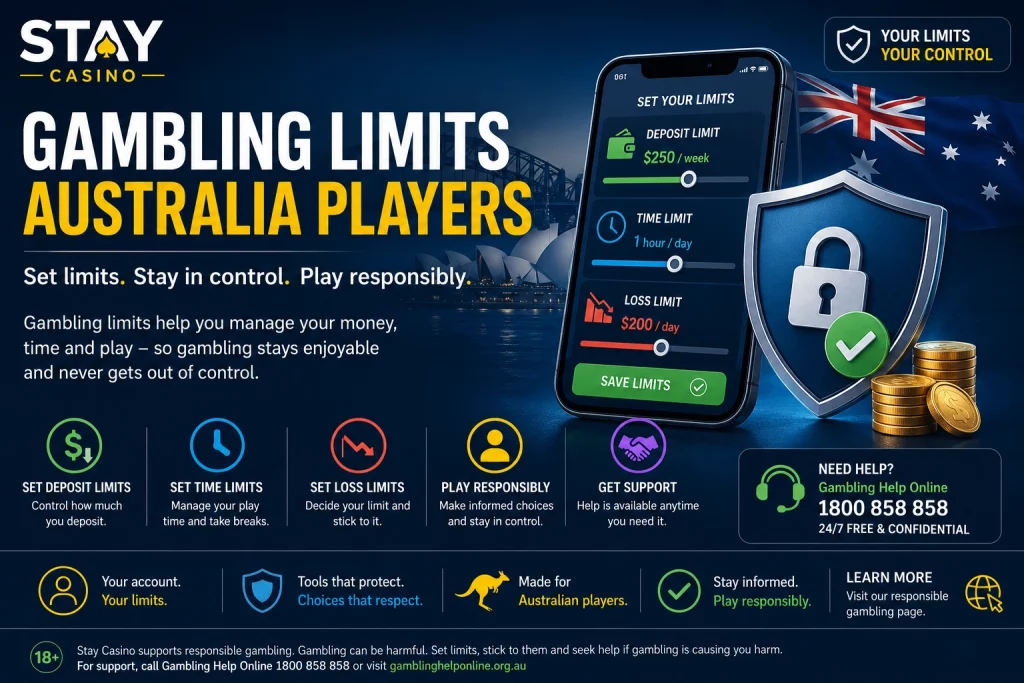
A responsible gambling page should also make clear that limits are not a guarantee of safety. They are tools. If someone repeatedly reaches their deposit limit, tries to raise it, opens extra accounts, borrows money, or feels irritated when access is blocked, the issue may already be more serious than simple limit-setting can manage. In that case, self-exclusion, counselling, financial support, or BetStop may be more appropriate.
For users who regularly access account pages such as Login, limits should be reviewed before signing in, not after gambling begins. The moment before account access is often the best time to ask: “Can I afford this?”, “Am I gambling calmly?”, and “Would stopping now be easier than stopping later?” If the answer feels uncertain, the safer decision is to avoid logging in and use support tools instead.
Main Gambling Limit Types for Australian Players
| Limit Type | What It Controls | Why It Helps | Useful Official Source |
|---|---|---|---|
| Deposit Limit | The amount of money a person can deposit into an account over a chosen period. | It creates a spending boundary before gambling starts. | Australian Government Gambling Reforms |
| Time Limit | The amount of time spent gambling in one session or across a day/week. | It reduces long, emotional, or repetitive gambling sessions. | Gambling Help Online |
| Loss Limit | The maximum amount a person is prepared to lose before stopping. | It prevents loss-chasing and protects essential money. | GambleAware NSW |
| Self-Exclusion | Access to licensed online and phone wagering providers. | It creates a stronger block when ordinary limits are not enough. | BetStop Australia |
Why Deposit Limits Should Be Set Early
Deposit limits work best when they are set before gambling becomes emotional. A player who sets a limit after losing money may choose an unrealistic amount because they are still focused on recovering losses. A calm limit should be based on disposable entertainment money only. Rent, food, transport, bills, savings, study costs, debt repayments, and family obligations should never be included in a gambling budget.
A deposit limit should also be lower than the amount a person thinks they can tolerate. This creates a margin of safety. If a player believes that losing $100 would be uncomfortable, the limit should not be $100. It should be lower, because gambling losses often feel more stressful after they happen than they did during planning.
Why Bonus Offers Should Not Control Limits
A common mistake is setting limits around promotional offers instead of personal affordability. A Bonus may appear attractive, but it can encourage higher deposits, longer sessions, or riskier behaviour if the person focuses on unlocking value rather than staying within a safe budget. The correct question is not “How much do I need to deposit to use this offer?” The correct question is “What amount can I afford to lose without stress?”
Bonus terms can also create pressure because they may include wagering requirements, expiry times, game restrictions, or maximum conversion rules. A responsible player should never increase a deposit limit just to activate or complete a promotion. If the offer only feels useful after increasing risk, it is not a safe offer for that player.
Personal Budgeting Before Gambling
A gambling limit should sit inside a wider personal budget. This means the person should know how much money is available after essential expenses. If the budget is unclear, gambling should not begin. Guessing available money is risky because small repeated deposits can create larger financial pressure by the end of the week or month.
A simple method is to divide money into three categories: essential costs, planned savings or debt payments, and optional entertainment. Gambling, if used at all by adults, belongs only in the optional entertainment category. Once that amount is gone, gambling should stop. It should not move into savings, bills, loans, or credit.
Time Limits Matter as Much as Money Limits
Money is not the only risk. Time can also become harmful. A person may stay within a deposit limit but still spend too many hours gambling, checking results, thinking about next bets, or reading game content. This can affect sleep, concentration, relationships, and daily responsibilities.
Time limits should be specific. “I will not play too long” is too vague. A stronger limit is: “I will stop after 30 minutes,” or “I will not gamble after 9 pm.” A clear time boundary is easier to follow and easier to measure. If a person repeatedly ignores time limits, that is a warning sign.
When Limits Are Not Enough
Limits are useful only when the person respects them. If someone constantly reaches the limit, feels angry when blocked, tries to increase it, or looks for another provider, the limit is no longer functioning as protection. That situation calls for stronger action, such as self-exclusion through BetStop, bank gambling blocks, counselling, or support from Gambling Help Online.
Australian players should treat repeated limit-breaking as serious information. It shows that access has become too easy or that gambling has become emotionally loaded. The safest response is not to raise the limit. The safest response is to step back.
Building a Responsible Limit Plan
A responsible limit plan should include money, time, and emotional checks. Before gambling, a person should know the maximum deposit, the maximum acceptable loss, the session length, and the reason for stopping. They should also decide what they will do if they feel frustrated, tempted to chase losses, or unable to stop.
The plan should be written down or saved somewhere visible. Mental limits are easier to change in the moment. Written limits create a firmer reference point. A player can compare their behaviour against the plan and decide whether gambling still feels controlled.
First Step for Australian Players
The first step is to set a deposit limit that reflects real affordability, not excitement, offers, or previous losses. The second step is to add a time limit. The third step is to prepare a stop rule. The fourth step is to know where to get help if those limits fail.
Gambling limits are not about reducing enjoyment. They are about preventing harm. If gambling remains adult entertainment, it must stay affordable, limited, and optional. When it stops feeling optional, the safest option is to stop gambling and use stronger support tools.
How Australian Players Can Use Limits Before Gambling Starts
A gambling limit should be active before a player deposits money, opens a game, or follows a promotion. Limits created after gambling starts are weaker because the person may already be influenced by excitement, frustration, or the desire to recover losses. For Australian players, the most useful approach is to treat limits as a pre-gambling checklist, not as a reaction after something goes wrong.
A player should decide three things in advance: how much money can be deposited, how much time can be spent, and what situation will trigger an immediate stop. This stop point might be reaching the deposit limit, losing a fixed amount, feeling irritated, playing longer than planned, or thinking about adding more money. The more specific the rule is, the easier it becomes to follow.
Deposit Limits and Account Setup
When a person reaches a Sign up page, the safest approach is to review responsible gambling tools before completing registration. If deposit limits are available during account setup, they should be used immediately. A new account without a limit creates unnecessary risk because the player may begin gambling before setting boundaries.
Deposit limits should be realistic and conservative. A limit should not be based on income alone. It should be based on money left after essential expenses, savings, debt payments, and daily living costs. If a person is unsure whether the money is truly disposable, the safest decision is not to deposit.
Practical Limit Checklist for Players
| Before Gambling | Question to Ask | Safe Decision | Warning Sign |
|---|---|---|---|
| Money Check | Is this money fully separate from bills, rent, food, transport, and savings? | Only gamble with clearly disposable entertainment money. | Using money needed later in the week or month. |
| Time Check | How long will this session last? | Set a specific session time and stop when it ends. | Playing without a clear finish point. |
| Emotion Check | Am I calm, or am I stressed, angry, bored, or chasing losses? | Do not gamble when emotions are driving the decision. | Using gambling to change mood or recover money. |
| Access Check | Can I stop easily if I reach my limit? | Use deposit limits, app removal, and bank blocks if needed. | Planning backup payment methods or extra accounts. |
Gambling Limit Balance
Why App-Based Access Needs Stronger Limits
Mobile gambling access can make limits more important because decisions happen quickly. A person may deposit during a short break, late at night, after a sports result, or while feeling stressed. This fast access reduces the natural pause that might exist with venue-based gambling.
For users who rely on an App, limits should be stricter than casual intentions. App notifications should be turned off, saved payment details should be removed where possible, and session times should be controlled. If the app becomes the easiest way to gamble impulsively, deleting it may be safer than keeping it installed.
Setting Time Limits That Actually Work
Time limits should be written as clear rules. A vague rule like “I will not play too much” gives the player too much room to keep going. A better rule is “I will stop after 30 minutes,” “I will not gamble after 9 pm,” or “I will only check results once.” Specific rules reduce negotiation during the session.
Time limits also protect attention. Gambling can become harmful even when spending is low if it occupies too much mental space. Constantly checking odds, results, games, promotions, or account balances can affect concentration and daily responsibilities. A player who spends hours thinking about gambling may need stronger controls even if deposits remain small.
Loss Limits and Stop Rules
A loss limit is the amount a person accepts as the maximum cost of entertainment. Once that amount is gone, the session is over. It should not be treated as the first stage before depositing again. The most important part of a loss limit is the stop rule attached to it.
A strong stop rule is simple: no extra deposits, no chasing, no switching games to recover money, and no returning later the same day to “try again.” If a player cannot follow this rule, the issue is not the size of the limit. The issue is that ordinary limits may no longer be enough.
Why Game Type Affects Limit Planning
Different gambling formats create different levels of risk. Fast games can produce repeated decisions in a short period. Sports betting can encourage repeated checking and emotional reactions to live events. Casino-style games may combine speed, visuals, and near-miss effects. Because of this, limits should reflect the gambling format, not only the player’s budget.
Players browsing Slots content should be especially careful with time and session limits. Slot-style games can move quickly, and repeated spins may make spending feel less noticeable. A responsible limit plan should include both a deposit cap and a clear session timer.
Limits Should Not Be Raised During Emotional Moments
A limit increase should never happen during frustration, excitement, boredom, or loss-chasing. In Australia, safer gambling rules around limit increases are designed to prevent instant escalation, but personal discipline still matters. If a player wants to increase a limit immediately after losing, that is a warning sign.
A safer approach is to keep the original limit and stop. If the person still believes the limit should change, they can review it later while calm. Even then, increasing a limit should be rare and carefully justified. Most responsible gambling plans focus on lowering limits over time, not raising them.
Combining Limits With Self-Exclusion Tools
Some players can manage risk with deposit and time limits. Others need stronger barriers. If limits are repeatedly reached, ignored, or increased, self-exclusion may be more appropriate. BetStop can help block access to licensed Australian online and phone wagering providers, while venue exclusion may be needed for physical gambling locations.
The safest decision is to move to stronger tools early. A person does not need to wait for serious financial harm before self-excluding. If gambling feels difficult to control, stronger protection is already justified.
Responsible Limit Habits for Australian Players
A responsible limit habit includes review. Players should check weekly or monthly whether their limits are still working. Useful questions include: Did I stay within my deposit limit? Did I stop on time? Did I think about gambling more than planned? Did I feel pressure to recover losses? Did gambling affect my mood?
If the answers show stress or repeated boundary-breaking, the limit plan should be tightened. This may mean reducing deposit limits, adding time restrictions, removing app access, blocking payments, or contacting support.
Gambling limits are only useful when they protect the person in real situations. The aim is not to create a formal rule that looks responsible but fails in practice. The aim is to make gambling easier to stop, easier to avoid, and easier to keep within safe boundaries.
Using Gambling Limits Across Different Game Types
Gambling limits should not be identical for every gambling format. Different activities create different risks. Some games move quickly, some encourage repeated small bets, some are connected to live events, and some make players stay longer because they feel close to a result. Australian players should choose limits based on how the game behaves, not only on how much money they have available.
A responsible limit plan should consider speed, session length, emotional intensity, and the chance of chasing losses. Faster formats usually need stricter limits because decisions happen more frequently. Slower formats still require control, especially when they involve long sessions or repeated checking.
Game-Type Limit Planning
| Game or Betting Type | Main Risk | Recommended Limit | Safer Behaviour Rule |
|---|---|---|---|
| Fast Casino Games | Repeated decisions in a short time | Short session limit and low deposit cap | Stop immediately when the timer or money limit is reached. |
| Sports Betting | Emotional reactions to live results | Daily deposit limit and no live-chasing rule | Do not place extra bets after a losing result. |
| Table Games | Long sessions and gradual bankroll loss | Loss limit plus fixed session length | Leave the table after the planned time, not after “one more round”. |
| Promotional Play | Depositing more to unlock offers | Promotion-independent deposit limit | Never increase a limit to claim an offer. |
Why Games Need Different Limits
Pages about Games may help users understand formats, but they can also become triggers for people who are trying to reduce gambling. A player who reads game guides, checks mechanics, or compares titles may start thinking about playing before reviewing limits. This is why responsible gambling guidance should appear before game access, not after it.
The safest structure is simple: review the limit first, then decide whether gambling is appropriate. If the player is already stressed, tired, bored, or focused on recovering losses, no game type is suitable. A limit cannot fully protect someone who is gambling for emotional relief.
Risk Factors by Gambling Format
Some formats can create a feeling of control even when outcomes remain uncertain. A player may believe that knowledge, timing, previous results, or game familiarity can protect them from loss. This belief can weaken limits because the player may think the next round or next bet will be different.
In reality, limits should be based on personal protection, not confidence. Even experienced players can overspend, chase losses, or stay longer than planned. A responsible limit does not ask whether the player understands the game. It asks whether the player can stop.
Gambling Risk Awareness
The Role of Cooling-Off Periods
Cooling-off periods can help when a player needs a short break rather than full self-exclusion. A cooling-off tool may temporarily block account access or restrict gambling for a limited period. This can be useful after a stressful session, repeated losses, or a moment when gambling starts to feel too automatic.
However, a cooling-off period should not be used as a way to return quickly after harm. If the same pattern repeats after every break, the player may need stronger protection. Full self-exclusion, bank blocking, and counselling may be more suitable than another short pause.
Limits for Players Who Gamble Casually
Casual gambling still needs limits. A person does not need to gamble every day to experience harm. Occasional gambling can still become risky if the deposits are too high, if the player gambles when emotional, or if losses affect essential money. The frequency of gambling is only one part of risk.
A casual player should set a monthly entertainment cap and avoid carrying unused gambling budget forward. For example, if someone chooses not to gamble one month, that amount should not automatically double the next month. Gambling money should remain limited, optional, and separate from life costs.
Limits for Players Returning After a Break
A player returning after a break should use lower limits than before, not higher ones. Returning can create a false sense of control, especially if the person believes that time away has removed all risk. A safer approach is to restart with strict deposit limits, short sessions, and no promotional pressure.
If the previous break was caused by stress, losses, conflict, or difficulty stopping, the player should consider whether returning is safe at all. A break does not guarantee that gambling behaviour has changed. If old patterns appear quickly, stronger action is needed.
Warning Signs That Limits Are Failing
Limits are failing when they become something to negotiate with rather than follow. If a player starts looking for reasons to increase a deposit cap, extend a session, change payment methods, or continue after a planned stop, the protective value of the limit is weakening.
Other warning signs include hiding gambling activity, feeling restless when unable to gamble, checking gambling content repeatedly, borrowing money, delaying bills, or gambling after promising not to. These behaviours suggest that a limit is no longer enough on its own.
How FAQ Content Should Support Safer Limits
A responsible FAQ section should not only answer technical questions. It should also guide players toward safer decisions. Questions about deposit limits, cooling-off periods, self-exclusion, account closure, and support services should be easy to find. The answers should be clear, practical, and non-promotional.
FAQ content should also explain that reducing a limit is usually safer than increasing one. Players should understand that higher limits are not rewards or account upgrades. They are higher-risk settings. If someone feels the need to increase a limit quickly, they should pause and review why.
Combining Internal Tools With External Support
Casino account tools can help, but they should not be the only protection. Australian players can also use external support such as BetStop, Gambling Help Online, state-based services, bank gambling blocks, and financial counselling. External tools are especially important when a person no longer trusts themselves to follow voluntary limits.
Support should be used early. A person does not need to wait for severe harm before asking for help. If gambling is causing anxiety, secrecy, debt pressure, or repeated conflict, support is already appropriate.
Practical Guidance for Stay Casino Readers
For Stay Casino readers, gambling limits should be treated as part of a wider responsible gambling structure. A safe limit plan includes a deposit cap, a time boundary, a stop rule, marketing control, and support options. If any part of the plan fails repeatedly, the player should reduce access rather than increase flexibility.
The main principle is simple: a limit should protect the person when motivation is weak. If the limit only works when the player is calm and disciplined, it is not strong enough. A useful limit creates friction, slows decisions, and makes stopping easier.
Maintaining Gambling Limits and Knowing When to Stop
Gambling limits are only useful when they continue to work in real situations. A player may set a deposit cap, time limit, or loss rule with good intentions, but the real test comes later: after a loss, during boredom, after receiving a promotion, or when gambling feels like an easy way to change mood. For Australian players, maintaining limits means checking behaviour regularly and acting early when those limits stop protecting them.
A strong limit plan should be reviewed weekly or monthly. The review should be honest and practical. Did the player stay within the deposit limit? Did they stop at the planned time? Did they feel pressure to continue? Did they think about gambling outside the session? Did they feel tempted to change the limit? If the answers show stress or repeated boundary-breaking, the safest response is to lower limits or stop gambling completely for a period.
Long-Term Gambling Limit Maintenance
| Maintenance Area | Recommended Action | Why It Matters | Warning Sign |
|---|---|---|---|
| Deposit Control | Keep deposit limits low and review them only when calm. | It prevents emotional increases after losses or promotions. | Wanting to raise the limit immediately after losing. |
| Session Control | Use a fixed time limit and stop when the timer ends. | It reduces long sessions and automatic gambling behaviour. | Continuing because the next round feels important. |
| Marketing Control | Turn off gambling notifications and avoid promotional messages. | It reduces triggers linked to bonuses and offers. | Opening emails or messages to “just check” offers. |
| Money Protection | Use bank gambling blocks or remove saved payment methods if needed. | It adds friction when urges appear. | Looking for new cards, wallets, or payment routes. |
| Support Access | Contact Gambling Help Online, BetStop, or a trusted support person when limits fail. | External support helps when personal rules are no longer enough. | Trying to hide gambling or manage strong urges alone. |
Why Review Matters After Every Gambling Session
A short review after gambling can prevent small problems from becoming repeated patterns. The player should ask whether the session stayed within the plan. If it did, the limit may be working. If it did not, the answer should not be to excuse the behaviour or create a more flexible rule. The answer should be to strengthen protection.
Reviewing behaviour also helps identify triggers. Some players gamble more after stressful workdays. Others gamble more late at night, after alcohol, during sports events, or after receiving promotions. Once a trigger is identified, the player can build a specific rule around it. For example, no gambling after 9 pm, no gambling during stress, no live betting after a loss, or no deposits after promotional emails.
When Links and Gambling Content Become Triggers
Responsible gambling content can help players make safer decisions, but gambling-related browsing can also become a trigger. Pages with Links to game categories, promotions, account tools, or casino reviews should be approached carefully by anyone who is trying to reduce gambling. If a player notices that reading gambling content creates an urge to deposit, that content should be avoided.
A useful rule is to separate support browsing from gambling browsing. Looking for BetStop, Gambling Help Online, bank gambling blocks, or counselling services is support browsing. Looking for new offers, game guides, bonus pages, or alternative gambling sites is gambling browsing. The difference matters because one direction helps reduce risk, while the other may increase it.
Player Protection Progress
Lowering Limits Is Usually Safer Than Raising Them
If a player is unsure whether a limit is too high, the safer choice is to lower it. Lower limits create more protection and reduce the chance of sudden harm. Raising limits should never be treated as a normal account adjustment, a loyalty benefit, or a response to a bigger bankroll. It is a higher-risk change and should be considered carefully.
The most dangerous time to raise a limit is immediately after a loss. At that moment, the player may believe they are making a rational decision, but the real motive may be recovery. Loss-chasing is one of the clearest warning signs in gambling. A limit should interrupt that behaviour, not adapt to it.
How Family or Friends Can Support Limit Control
Some players benefit from sharing their gambling limits with a trusted person. This does not need to be dramatic or public. A simple conversation can help create accountability. For example, the player can say that they have set a weekly deposit limit, removed app notifications, or decided not to gamble after a certain time.
A trusted person can also help notice changes in behaviour. If gambling becomes secretive, emotional, or financially stressful, outside perspective can be useful. Support should not be based on blame. The goal is to help the person stay aligned with the limit plan they already chose.
When to Move From Limits to Self-Exclusion
Gambling limits are suitable when the player can follow them consistently. If the player repeatedly breaks limits, tries to bypass them, hides gambling, or feels unable to stop, self-exclusion should be considered. BetStop provides a national self-exclusion register for licensed Australian online and phone wagering providers, while venue-based exclusion may be needed for clubs, pubs, casinos, or gaming rooms.
Self-exclusion is not a punishment. It is a stronger protective tool. A player who chooses it is not losing control of their life; they are creating a safer structure because ordinary limits are no longer enough. Early self-exclusion can prevent deeper harm.
Final Guidance for Australian Players
Gambling limits should protect money, time, attention, and wellbeing. They should be set early, kept conservative, and reviewed honestly. A safe gambling limit is not the highest amount a person can technically afford. It is the lowest practical boundary that keeps gambling from affecting real life.
Australian players should remember that gambling must remain optional, limited, and affordable. If gambling becomes stressful, secretive, repetitive, or financially uncomfortable, the safest action is to stop and use support services. Deposit limits, time limits, loss limits, bank blocks, BetStop, and Gambling Help Online all serve the same purpose: reducing harm before it becomes harder to manage.
A responsible player does not wait for a crisis to act. Lowering limits, taking a break, blocking access, or asking for help are all valid decisions. Gambling should never come before bills, health, relationships, work, study, or personal safety.






Comments