
Online Gambling Laws in Australia Explained
What Australian Online Gambling Law Actually Covers
Online gambling law in Australia is not a single simple rule. It is a framework that separates different gambling products, different operators, different communication channels, and different user-protection obligations. For Stay Casino readers, the most important point is that a gambling website being available online does not automatically mean it is legal, safe, or protected for Australian users.
Australia’s main federal law for online gambling is the Interactive Gambling Act 2001. ACMA explains that this law makes it illegal for gambling providers to offer some online services to people in Australia, including prohibited interactive gambling services. ACMA also publishes information about licensed interactive wagering providers and illegal services.
This distinction matters because many users confuse access with legality. A website may load in a browser, accept an Australian visitor, show Australian-style currency references, or advertise casino-style entertainment, but that does not prove lawful operation. A legal review must look beyond the page design and check whether the service is permitted, registered where required, and accountable.
Why “Available in Australia” Does Not Mean Legal
Some offshore gambling sites target Australian users even when the service does not provide the same protections as licensed services. ACMA specifically warns that some online gambling services may look legal in Australia and may target Australian players, but users might not receive the same customer protection as with licensed services. ACMA lists illegal online services including slots, casino-style games such as poker, blackjack and roulette, scratchies, in-play betting on sporting events, and betting or lottery services not licensed in Australia.
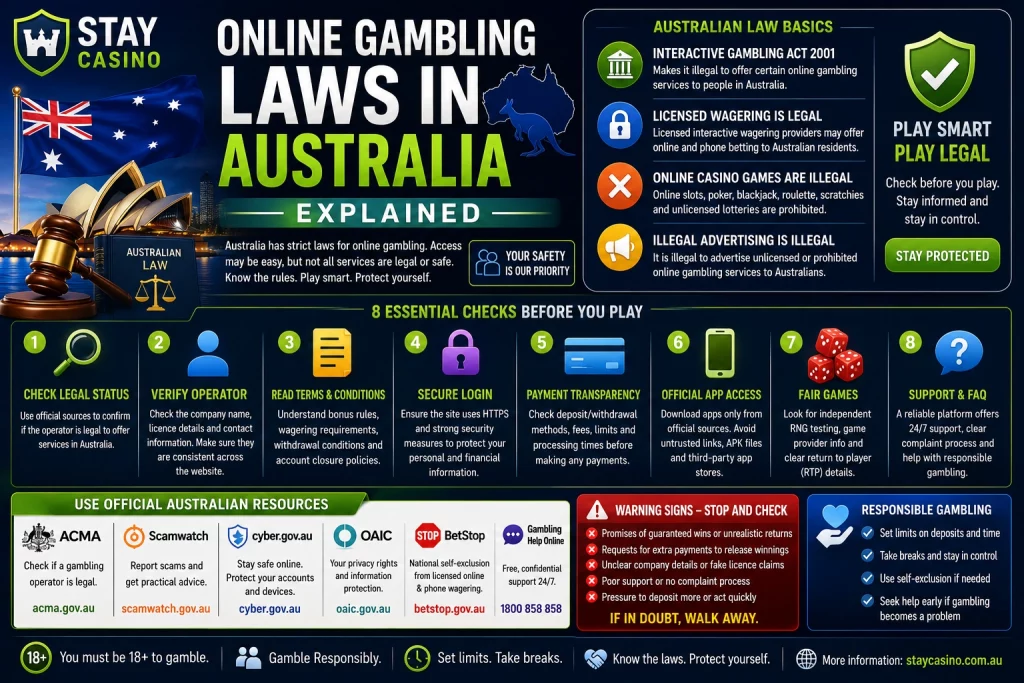
This is one of the most important safety principles on the page: visibility is not legality. Search engines, social networks, affiliate pages, mirror domains, and messaging apps can still expose users to unlawful or risky services. A user should not rely on advertising claims, bonus banners, or “Australia friendly” language.
A safer approach is to check official regulatory information before any account action. ACMA says a gambling operator must be on the register of licensed interactive gambling providers to operate in Australia.
The Role of ACMA
ACMA is the Australian Communications and Media Authority. In the online gambling context, it provides information about the Interactive Gambling Act, investigates breaches, publishes regulatory guidance, and takes action against illegal online gambling services.
ACMA can investigate anyone who breaks rules for online and phone gambling services, including providing or advertising illegal online gambling services. It also publishes information about blocked illegal gambling websites, because some services continue trying to reach Australian users despite enforcement activity.
For users, ACMA’s role is practical. It gives a way to check whether a wagering provider is licensed, understand illegal online gambling risks, and avoid operators that may not provide customer protection.
Login Safety Under Australian Gambling Law
The Login page is not just a convenience feature. It is a legal and security checkpoint. If a website’s operator status is unclear, entering login credentials may expose personal data to an unaccountable service.
Before using any login page, users should check whether the site identifies the operator, explains the legal basis of the service, uses HTTPS, avoids suspicious redirects, and provides clear account recovery. If a login link comes from a message, advertisement, or social media post, it should be treated carefully.
A fake or unlawful gambling site may copy legitimate branding to collect passwords. Legal uncertainty and account-security risk often appear together. If the service cannot explain its Australian legal position, users should avoid account access.
Bonus Advertising and Legal Risk
The Bonus section can create a false impression of legitimacy. Large promotional offers, free spins, cashback wording, loyalty points, and urgent countdown timers may make a site look active and professional. However, promotion does not prove legal status.
Australian online gambling laws also interact with advertising rules. ACMA’s investigation powers cover advertising of prohibited or unlicensed regulated interactive gambling services. That means users should be cautious when a site heavily promotes casino-style products while giving little legal information.
A safer legal review treats promotional pages as risk areas. Users should check whether the site clearly explains eligibility, wagering requirements, withdrawal conditions, responsible gambling tools, and legal status before any registration or payment.
Sign-Up and Personal Data Exposure
The Sign up process may collect sensitive information, including name, date of birth, address, phone number, email address, payment details, device data, and identity documents. That data should never be shared before legal and privacy checks are complete.
A lawful and accountable operator should clearly explain who controls user data, why information is collected, how it is stored, and how users can raise privacy questions. If the website asks for registration before showing operator identity or legal terms, that is a weak safety signal.
For Australian users, the safest order is verification first, registration second. If legal status is unclear, there should be no sign-up.
| Legal Topic | What It Means in Australia | User Safety Check |
|---|---|---|
| Interactive Gambling Act | The federal law that restricts certain online gambling services offered to people in Australia | Check whether the site explains how it complies with Australian rules |
| Licensed providers | Legal interactive wagering providers must appear on the relevant official register | Use official sources rather than relying on the website’s own badge |
| Illegal online services | ACMA identifies online slots, casino-style games, scratchies, and unlicensed betting or lottery services as illegal online services | Do not assume access from Australia means protection or legality |
| Advertising risk | Illegal gambling advertising can be investigated and acted against | Be cautious with aggressive promotions and social media gambling ads |
| Self-exclusion protection | BetStop covers licensed Australian online and phone wagering providers | Use self-exclusion tools if gambling access needs to be blocked |
App Access and Mobile Law Confusion
A gambling-related App can make legal risk harder to notice. Mobile apps may use push notifications, stored sessions, faster account access, and simplified payment flows. This can reduce the time users spend checking terms, operator identity, and legal status.
Users should avoid unofficial app downloads, direct APK files, mirror links, social media download prompts, and apps that do not match the operator’s legal information. If the website’s legal status is unclear, the mobile app should not be trusted.
Mobile convenience should not replace legal verification. A safe app experience should include clear operator identity, privacy terms, responsible gambling tools, account closure options, and secure access.
Slots, Casino-Style Products, and Australian Restrictions
Australian users should treat Slots and casino-style Games with special caution online. ACMA’s public guidance identifies online slots and casino-style games such as poker, blackjack and roulette as illegal online services when offered to people in Australia by prohibited services.
This does not mean every gambling-related website is the same. It means that users must understand the product type, operator status, and Australian legal context before trusting any service.
Game graphics, provider logos, demo modes, “RNG tested” labels, and jackpot visuals do not prove legality. The legal question is not whether the game looks familiar. The question is whether the service is permitted for Australian users and whether it provides recognised protections.
FAQ and Links as Legal Safety Tools
A strong legal FAQ should explain Australian online gambling rules in plain language. It should cover operator status, legal restrictions, payment risk, account closure, complaints, self-exclusion, privacy, and gambling support.
Useful Links should lead users toward official regulatory and safety resources, not only commercial pages. BetStop is a free Australian Government initiative that lets people block themselves from licensed Australian online and phone gambling providers; once registered, providers cannot let the person place a bet, open new betting accounts, or receive marketing messages.
Legal pages should reduce risk. If a FAQ only discusses promotions, access, or deposits, it is not giving users enough legal safety context.
Why BetStop Matters in the Legal Framework
BetStop is part of Australia’s user-protection environment. It does not make unsafe gambling safer, but it gives people a way to block access to licensed Australian online and phone wagering providers.
This is especially important for users who feel gambling is becoming difficult to control. A legal explanation should not only discuss what operators can or cannot offer. It should also explain how users can reduce access, stop marketing, and seek help.
Gambling Help Online says users can speak with a gambling counsellor 24/7 across Australia, and the service is free, professional, and confidential.
The Difference Between Wagering and Casino-Style Gambling
Australian online gambling law makes important distinctions between different product types. This matters because many users see gambling websites as one category, when the legal framework treats them differently. Online wagering, casino-style gambling, lotteries, advertising, credit betting, and in-play betting may each raise different compliance questions.
For users, the practical point is simple: a platform being connected with one legal gambling product does not automatically mean that every product on the site is lawful for Australian users. A wagering provider may operate under one framework, while online casino-style products may raise different legal restrictions.
This is why Australian users should not rely on broad claims such as “licensed gaming,” “legal betting,” or “international operator.” The exact product matters. The operator should explain what it offers, where it is authorised, which users may access it, and what rules apply.
Why Product Type Matters
Product type is central to legal risk. A site may use casino-style design, card game graphics, live dealer imagery, jackpot language, and slot-style animations while presenting itself as a general entertainment platform. That can make the legal position difficult for users to understand.
A safer legal review asks: is the site offering wagering, casino-style products, lotteries, games of chance, simulated games, or promotional content? Is the product real-money or demo-only? Does the platform accept Australian users? Does it process payments? Does it advertise bonuses?
If the website does not explain these details clearly, users should treat it as risky. Product ambiguity is not a harmless detail. It affects legality, payment protection, complaint options, and responsible gambling support.
| Product or Feature | Legal Review Question | User Risk If Unclear |
|---|---|---|
| Online wagering | Is the provider listed as a licensed interactive wagering operator where relevant? | The user may rely on a service without recognised Australian protections |
| Casino-style products | Does the site explain whether the product is permitted for Australian users? | The user may access a prohibited or offshore service without clear remedies |
| Promotional offers | Are advertising claims, bonus rules, and eligibility conditions clear? | The user may be pushed into risky account action before legal checks |
| Mobile access | Does the app match the same operator, terms, and privacy policy as the website? | The user may install unsafe software or share data with an unclear entity |
| Payment flow | Are deposits, withdrawals, fees, limits, and verification rules visible before payment? | The user may face withdrawal disputes or unclear transaction handling |
Offshore Operators and Australian Users
Offshore gambling sites can create confusion because they may claim to be licensed somewhere else. An offshore licence may exist, but users still need to ask whether the service is lawful for people in Australia and whether Australian consumer protections apply.
A foreign licence badge does not automatically create Australian legal permission. Users should not assume that a licence in another jurisdiction covers access, advertising, payments, or casino-style products offered to Australian residents.
The safest review focuses on Australian relevance. Does the operator explain its status in Australia? Does it provide clear legal information for Australian users? Does it appear in official Australian regulatory resources where relevant? Does it avoid prohibited product claims?
If the site relies only on offshore wording, legal confidence should remain low.
Advertising and Affiliate Pages
Advertising can make legal review harder. Some users reach gambling sites through comparison articles, bonus pages, social media posts, short links, influencers, email promotions, or search ads. These pages may use strong promotional language without explaining legal restrictions.
Affiliate pages can also blur responsibility. A review site may promote a gambling operator without clearly explaining whether the service is legal, authorised, or suitable for Australian users. Users should not rely on commercial rankings as legal advice.
A safer approach is to separate marketing from verification. Before trusting any operator promoted by an external page, users should check the operator directly, review official resources, and look for consistent legal, payment, and responsible gambling information.
Legal Clarity Across the User Journey
Payments Under Legal Uncertainty
Legal uncertainty becomes more serious when payment is involved. A site that is unclear about its Australian status should not be trusted with deposits, payment credentials, banking information, or identity documents.
A safer platform should publish payment conditions before users take action. These conditions should include minimum and maximum deposit amounts, withdrawal limits, processing times, fees, payment ownership rules, verification requirements, and dispute procedures.
If the site makes deposits simple but withdrawals unclear, that is a major risk. If the site asks for additional payments to release funds, users should stop immediately. Phrases such as “release fee,” “clearance payment,” “tax unlock,” “verification charge,” or “VIP upgrade before withdrawal” are serious warning signs.
Identity Verification and Law
Identity verification can be part of regulated gambling operations, but it should be explained clearly. Users should know why documents are requested, how they are uploaded, who reviews them, how long they are stored, and how privacy questions can be raised.
A site with unclear legal status should not receive identity documents. Passports, driver licences, utility bills, bank statements, and card images can create identity-theft risk if sent to an unsafe platform.
Users should avoid document requests sent through social media, messaging apps, temporary live chat, or informal email addresses. A secure upload process and consistent operator identity are minimum safety expectations.
Responsible Gambling and the Law
Responsible gambling tools are an essential part of the user-protection environment. They do not remove legal risk, but they show whether the platform recognises user safety as a serious obligation.
Users should look for deposit limits, time reminders, cooling-off tools, account closure, self-exclusion information, support contacts, and marketing opt-out options. These features should be easy to find before gambling behaviour becomes harmful.
A platform that hides responsible gambling information while aggressively promoting deposits or bonuses should be treated with caution. Legal clarity and user protection should work together.
State and Territory Context
Australia has both federal and state or territory gambling rules. The Interactive Gambling Act is a federal framework focused on online and phone gambling services, while states and territories also regulate aspects of gambling, licensing, venues, and consumer protections.
For users, the key lesson is not to assume one simple nationwide answer covers every product or operator. A lawful arrangement may depend on the product type, operator status, location, licensing pathway, and communication method.
Because the rules can be complex, users should rely on official sources rather than promotional explanations. If a website summarises the law in a way that sounds convenient but provides no official support, users should not treat it as reliable.
Why Complaints Matter
Complaint handling is part of legal accountability. A safer gambling-related platform should explain how users can raise issues about payments, verification, account access, privacy, promotions, or responsible gambling controls.
If a website offers deposits but does not explain how complaints are handled, accountability is weak. If support provides only temporary chat replies and no written escalation path, users may struggle to document disputes.
Before any account action, users should check whether the site has a complaints section, whether the operator identity is clear, and whether support can answer legal and payment questions without pressure.
Why Enforcement Matters for Australian Users
Australian online gambling law is not only about written rules. It is also about enforcement, consumer protection, and harm reduction. A user may read a gambling website’s own legal page and see confident claims, but those claims only matter if the operator is accountable to a real framework.
For Stay Casino readers, enforcement should be understood as a practical safety layer. If a gambling-related service breaches Australian rules, hides ownership, promotes prohibited products, or targets Australian users without proper authorisation, users may have fewer protections when problems occur. This can affect payment disputes, blocked withdrawals, account closure, privacy complaints, and marketing pressure.
The most important lesson is that users should not treat gambling websites as self-verifying. A site can claim to be legal, safe, licensed, certified, or globally trusted, but users need independent confirmation. Without external verification, the claim remains only a claim.
Illegal Gambling Advertising
Advertising is a major part of online gambling risk. Some users do not reach gambling websites directly. They arrive through social media ads, comparison pages, influencer posts, email campaigns, SMS messages, private groups, search ads, or “exclusive bonus” pages.
This creates a legal safety problem. Promotional pages often focus on urgency and rewards rather than restrictions, risks, or Australian legal context. A user may see an offer before they see the operator name. They may see a sign-up button before they see legal terms. They may see a reward claim before they understand whether the product is allowed for Australian users.
A safer legal review treats advertising as an entry point, not as proof. If an advertisement directs users to a gambling-related service, the user should still check the operator, legal status, product type, payment rules, privacy policy, and responsible gambling tools before taking any action.
Why Bonus Pages Need Legal Review
Bonus pages can create legal and financial risk when they hide conditions. A gambling-related promotion should not be evaluated only by its headline amount. Users need to review eligibility, wagering requirements, expiry dates, maximum bet limits, withdrawal caps, restricted products, payment conditions, and verification requirements.
A risky offer often uses simple language at the top and complicated restrictions in the terms. This imbalance can mislead users who act quickly. A responsible legal review should slow the process down.
If a promotion makes urgent claims but the legal page is vague, users should not continue. Strong advertising and weak legal disclosure are a poor combination.
User Protection Areas in Australian Online Gambling
| User Protection Area | What It Should Explain | Risk If Missing |
|---|---|---|
| Advertising transparency | Offers, eligibility, restrictions, expiry dates, and product limits should be clear | Users may act on misleading or incomplete promotional claims |
| Operator accountability | The site should identify the company, legal basis, support route, and complaint process | Users may struggle to resolve disputes or identify who controls the service |
| Payment fairness | Deposits, withdrawals, fees, verification, processing times, and rejected withdrawal reasons should be visible | Users may face unclear cashout delays or unexpected conditions |
| Privacy control | Data collection, storage, sharing, document handling, and marketing consent should be explained | Personal information may be exposed to unclear or unsafe handling |
| Harm prevention | Limits, cooling-off, self-exclusion, support contacts, account closure, and marketing opt-out should be easy to use | Users may find it harder to reduce access when gambling becomes risky |
Privacy Duties and Data Safety
Online gambling law and privacy risk often overlap. A gambling-related website can collect sensitive information before the user fully understands who operates it. That information may include identity details, address data, payment records, device data, gameplay history, support messages, marketing preferences, and uploaded documents.
A safer website should have a specific privacy policy. It should identify the company responsible for data, explain why information is collected, describe third-party sharing, outline retention practices, and provide a contact route for privacy questions.
Users should avoid platforms that use copied privacy text, wrong company names, missing contact details, or vague claims about “secure storage” without explaining the process. If the operator identity is unclear, the data controller is also unclear.
Identity Documents and Legal Risk
Identity verification can be legitimate in regulated gambling environments, but it must be handled carefully. A user should know what documents may be required, why they are needed, how they should be uploaded, who reviews them, how long review may take, and how the documents are protected.
A site with uncertain legal status should not receive identity documents. Passports, driver licences, utility bills, bank statements, and card images can create serious identity risk if sent to an unsafe or unaccountable operator.
Warning signs include requests through social media, chat apps, personal email addresses, temporary live chat, or third-party upload links that do not match the operator. If the document process feels informal, users should stop.
Official Resources for Legal and Safety Checks
| Resource | Purpose | Useful Link |
|---|---|---|
| ACMA | Check whether a gambling operator is legal and review Australian online gambling guidance | ACMA legal gambling operator check |
| ACMA illegal gambling guidance | Understand illegal online gambling services and user protection risks | ACMA illegal gambling operator guidance |
| Scamwatch | Recognise scams, report suspicious activity, and review scam-prevention advice | Scamwatch |
| Cyber.gov.au | Learn about phishing, password safety, account protection, and cyber security | Australian Cyber Security Centre |
| OAIC | Review privacy rights and personal information protection guidance | OAIC privacy guidance |
| BetStop | Use national self-exclusion from licensed Australian online and phone wagering providers | BetStop |
| Gambling Help Online | Access free confidential gambling support and self-help resources | Gambling Help Online |
Complaint Handling and Evidence
Complaint handling is an important part of user protection. A safer gambling-related website should explain how users can raise issues about payments, withdrawals, verification, privacy, account access, promotional terms, and responsible gambling tools.
A complaint process should be written and traceable. Temporary chat messages are not enough. Users should be able to save complaint IDs, email records, screenshots, transaction numbers, terms, and support replies.
If a website has no complaint process, no escalation route, or no identifiable operator, users may have limited practical options when something goes wrong. This is why complaint review should happen before account creation.
Legal Pages Should Not Be Decorative
Some websites create legal pages only to appear serious. These pages may contain long blocks of text, formal wording, and generic legal phrases, but still fail to answer basic questions.
A useful legal page should identify the operator, explain the legal basis of the service, describe product restrictions, outline payment rules, show complaint options, link to responsible gambling tools, explain privacy practices, and clarify account closure.
If the legal page sounds official but avoids practical detail, users should not treat it as reliable. Legal wording is only useful when it creates accountability.
Marketing Consent and Responsible Communication
Marketing control is another legal and safety issue. Gambling-related messages can encourage impulsive decisions, especially when they use urgency, limited-time offers, or loss-recovery language.
Users should check whether the website explains how marketing consent is collected and how promotional messages can be stopped. A safer platform should provide unsubscribe options, account notification controls, and marketing opt-out routes.
If a user has requested account closure, self-exclusion, or marketing removal, continued promotional contact is a serious warning sign. Communication controls are part of user protection.
Reputation Patterns and Legal Trust
External reviews should not replace official legal checks, but they can reveal operational patterns. Users should look for repeated issues rather than isolated comments.
Common patterns that reduce legal trust include delayed withdrawals, changing verification demands, fake licence claims, ignored complaints, copied legal pages, unclear payment entities, and support that avoids direct questions.
A safe review combines multiple signals. Official resources show legal context. The website shows operator transparency. Payment terms show financial fairness. Privacy pages show data accountability. User feedback shows practical experience.
Why the Final Review Should Focus on Risk Reduction
Online gambling laws in Australia should be understood as a user-protection framework, not just a technical legal topic. The purpose of a legality review is to help users avoid unsafe gambling-related websites, unclear operators, illegal product offers, payment disputes, privacy exposure, and gambling harm.
For Stay Casino readers, the most practical lesson is that Australian online gambling law does not allow users to rely on surface signals. A professional-looking website, fast account page, polished support chat, strong offer, or casino-style game library does not prove that the service is legal or safe.
The safest approach is to check the legal status before any action. That means before registration, before entering login details, before accepting an offer, before downloading an app, before uploading documents, and before making a payment. If the legal position is unclear, users should stop.
Final Legal Safety
| Final Legal Check | What Users Should Confirm | Stop If This Is Unclear |
|---|---|---|
| Australian legal status | The service explains whether it is permitted for Australian users and provides verifiable legal information | The website is accessible but gives only vague offshore or “internationally licensed” claims |
| Product type | The platform clearly explains whether it offers wagering, casino-style games, lotteries, promotional content, or another product type | Casino-style features appear without clear Australian legal context |
| Operator identity | The same company name appears across the footer, terms, privacy policy, payment pages, and support replies | Different company names, copied legal wording, or anonymous ownership appear |
| Payment and withdrawal rules | Deposits, withdrawals, fees, limits, verification steps, and complaint routes are visible before payment | Withdrawal rules are hidden, extra release fees appear, or support avoids payment questions |
| User protection | Privacy policy, secure document upload, account closure, limits, self-exclusion, and support resources are easy to find | Documents are requested unsafely or responsible gambling tools are hidden |
Legal Confidence Across the Full Review
The Main Legal Difference Users Should Understand
The main difference users should understand is that Australian law does not treat every online gambling activity in the same way. Some forms of licensed interactive wagering may operate within a regulated framework, while online casino-style services can fall into prohibited categories when offered to people in Australia.
This distinction matters because many gambling websites use similar design language. Sports betting pages, casino-style games, jackpot graphics, live tables, slots, lotteries, scratch-style games, and promotional landing pages may all appear under one broad “gaming” presentation. A user cannot judge legality by appearance.
The product must be checked. The operator must be checked. The Australian legal context must be checked. If the platform does not explain these points clearly, the safest decision is to avoid account action.
Why Offshore Claims Are Not Enough
Many gambling-related websites rely on offshore licensing language. They may state that they are registered overseas, licensed in another jurisdiction, certified internationally, or trusted by global players. These claims may sound reassuring, but they do not automatically mean the service is lawful or protected for Australian users.
A foreign licence claim should never be treated as a complete answer. Users should ask whether the operator is permitted to offer that specific product to Australian users, whether the service is listed where relevant, whether Australian protections apply, and whether complaints can be raised through an accountable process.
If the website cannot connect its legal claim to the Australian user’s situation, the claim is incomplete.
Why Legal Pages Should Be Practical
A legal page is useful only if it answers practical questions. Long formal wording is not enough. The page should explain who operates the service, what products are offered, what legal framework applies, how payments are handled, how identity verification works, how data is protected, how complaints can be raised, and how a user can close an account or activate responsible gambling tools.
Users should be cautious when a legal page sounds official but avoids basic operational details. Copied wording, broken links, missing operator names, unclear payment entities, and vague jurisdiction claims reduce trust.
Legal transparency should be simple to verify. If it is difficult to understand who is responsible, the user should not proceed.
Payment Rules as Legal Evidence
Payment rules show whether the platform is operating transparently. A legally safer site should explain deposit methods, withdrawal methods, processing times, limits, fees, payment ownership requirements, verification conditions, and dispute procedures before any transaction.
Hidden payment rules are a major warning sign. A user should not discover withdrawal limits only after depositing. A user should not be told to pay an extra fee to release funds. A user should not receive changing verification demands without clear reasons.
If the payment path is unclear, the legal trust level should fall. Money should not be sent to an operator that cannot explain its own payment process.
Privacy and Identity Protection
Legal review must include privacy review. Gambling-related websites can collect sensitive information such as name, date of birth, address, phone number, email, payment records, device information, betting or game activity, support messages, and identity documents.
The privacy policy should identify the same company named in the legal section. It should explain data collection, storage, sharing, retention, and user contact rights. It should not contain unrelated company names or generic copied language.
Identity documents require special caution. Passports, driver licences, bank statements, and utility bills should never be sent through social media, informal chat, unknown email addresses, or suspicious upload links. If the operator identity is unclear, document upload is unsafe.
Advertising Pressure and Legal Risk
Advertising can create legal confusion. Some users first encounter gambling websites through promotional pages rather than official information. These pages may highlight offers, bonuses, jackpots, free spins, or fast registration while hiding legal context.
Users should treat urgent advertising as a reason to slow down. Countdown timers, guaranteed reward claims, instant profit wording, and “exclusive access” language should not replace legal checks.
A safer website gives users time and information. It does not rely on pressure to move users quickly from advertisement to registration or payment.
Responsible Gambling and Legal Safety
Responsible gambling tools are part of a safer legal environment. They show whether the platform gives users practical ways to reduce access, control spending, pause activity, close accounts, stop marketing, or seek support.
Users should look for deposit limits, session reminders, cooling-off options, self-exclusion information, account closure procedures, and links to support services. These tools should be available before harm escalates.
A website that promotes gambling heavily but makes harm-reduction tools difficult to find is not user-protective, even if it uses legal-sounding language.
What Users Should Do When a Site Looks Illegal or Unsafe
If a gambling-related website looks illegal, unclear, or unsafe, users should not continue. They should not register, log in, deposit, accept promotional terms, download apps, or upload documents.
If the user has already shared information, the next step should be damage reduction. They should change reused passwords, secure email accounts, review payment activity, contact their bank or payment provider if necessary, save screenshots, and report suspicious activity through relevant official channels.
If gambling access feels difficult to control, support should come before further platform review. Legal uncertainty and gambling harm risk can overlap, especially when a site uses pressure tactics or repeated promotional messages.
Final Answer: Online Gambling Laws in Australia Explained
Online gambling laws in Australia create a strict framework around what providers may offer, how services may be advertised, and how users should be protected. The key point for Stay Casino readers is that online access does not prove legality. A site may open in Australia and still create legal, financial, privacy, or wellbeing risk.
Users should check product type, operator identity, Australian legal status, official resources, payment transparency, privacy policy, complaint routes, advertising claims, and responsible gambling tools before any account action.
If the service cannot prove its legal position clearly, users should stop. If the product type is unclear, users should stop. If payment rules are hidden, users should stop. If identity documents are requested through unsafe channels, users should stop. If responsible gambling tools are missing, users should stop.
The safest rule is evidence first, action second. Legal clarity should come before login, sign-up, app download, payment, document upload, or promotional participation.






Comments