
Scam Casino Warning Signs Australia
Why Scam Casino Warning Signs Matter
Scam casino warning signs are important for Australian users because unsafe gambling websites can look polished, modern, and convincing. A scam platform may use professional graphics, large welcome offers, fake licensing badges, copied privacy policies, fake reviews, and urgent promotional messages to create trust quickly. The goal is usually to collect deposits, personal data, identity documents, or payment information before the user realises something is wrong.
For Stay Casino readers, this page is written as a safety and awareness guide. It does not promote gambling or recommend gambling platforms. Instead, it explains how to recognise suspicious behaviour, avoid risky sites, protect personal information, and choose support or reporting channels when something appears unsafe.
Australia has strict rules around online gambling services. ACMA warns that if Australians gamble online using a company that operates illegally, they risk losing their money and may not receive the same protections available under Australian law. ACMA also continues to investigate and request blocking of illegal online gambling sites when services breach the Interactive Gambling Act 2001.
Scam Casino Sign 1: No Clear Licensing or Ownership
One of the strongest warning signs is unclear ownership. A legitimate gambling-related platform should identify the company operating the site, its licensing details, terms, privacy policy, and support process. Scam sites often hide behind vague wording such as “internationally licensed” or “globally trusted” without giving verifiable details.
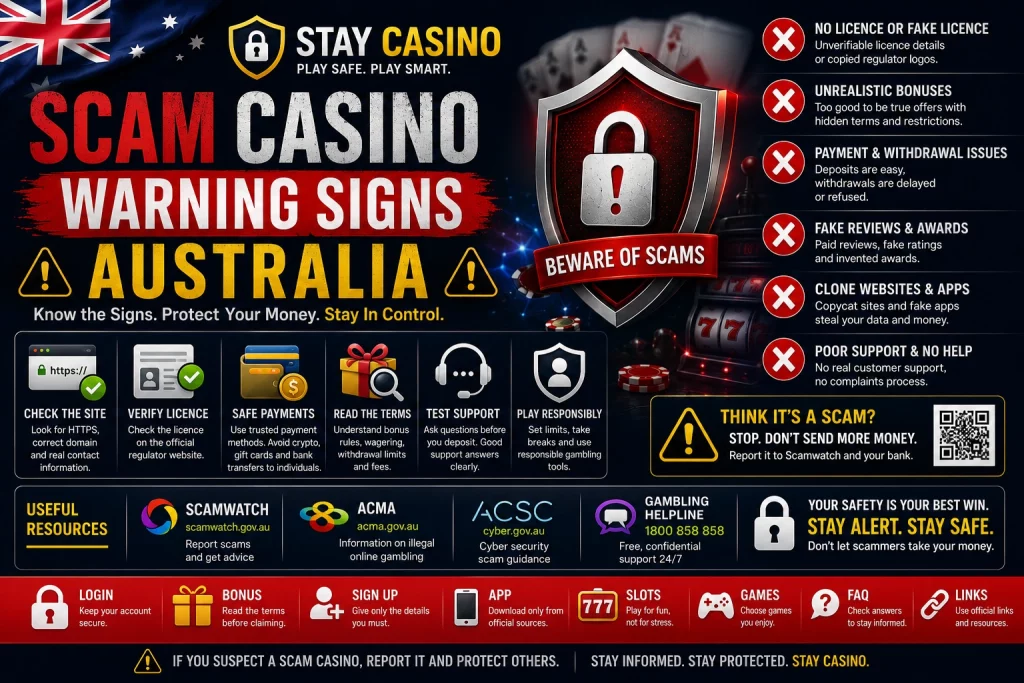
Some unsafe websites display fake regulator badges or logos that do not link to any official register. Others copy the design of real brands, use similar names, or create mirror domains that look almost identical to legitimate sites.
A user should not trust a site simply because it has an attractive homepage. If the operator name, licence, jurisdiction, and complaint process cannot be checked, the risk is high.
Scam Casino Sign 2: Suspicious Login Pages
The Login page is a common target for scams. Fake casino sites may imitate login screens to collect usernames, passwords, email addresses, or payment access details. These pages may arrive through phishing emails, SMS messages, social media posts, or fake support chats.
The Australian Cyber Security Centre explains that phishing messages can arrive by email, SMS, social media, instant messaging platforms, or phone calls, and they often look convincing while trying to trick people into sharing sensitive information such as passwords or banking details.
Before entering account details, users should check the domain carefully. Misspellings, strange redirects, browser security warnings, or unusual login prompts are serious red flags. A safe habit is to open a site manually through a trusted address rather than clicking unexpected messages.
Scam Casino Sign 3: Unrealistic Bonus Promises
A suspicious Bonus offer is another common warning sign. Scam casino pages often promise extreme rewards, guaranteed winnings, instant withdrawals, risk-free play, or “limited time” offers that pressure users to deposit immediately.
A legitimate offer should have clear terms. These include wagering requirements, withdrawal limits, game restrictions, expiry dates, maximum bet rules, and identity verification conditions. If the offer sounds too good to be true, creates urgency, or hides the rules, it should be treated with caution.
Scamwatch, the Australian Government’s scam awareness site, specifically warns people to learn how to spot and avoid scams and provides ways to report suspicious activity. It also identifies fake online gambling and betting sites as part of scam activity seen in Australia.
Scam Casino Sign 4: Risky Sign-Up Process
The Sign up process should never feel rushed, confusing, or unsafe. Scam sites often push users to register before showing legal terms, privacy policies, payment rules, or responsible gambling information. They may ask for identity documents before explaining how files are stored, who reviews them, or why they are required.
A suspicious registration flow may include unclear document upload forms, strange payment prompts, unverifiable age checks, or automatic redirection to other gambling pages. Users should avoid entering personal information if the site does not explain who operates it and how data is protected.
Personal information shared with a scam site can be misused for identity theft, account takeover, spam, or financial fraud.
| Warning Sign | What It May Mean | Safer Response |
|---|---|---|
| No clear licence or owner | The operator may be illegal, fake, or difficult to hold accountable | Do not share personal data or deposit money |
| Suspicious login page | The page may be phishing for passwords or account details | Close the page and access only through a trusted address |
| Unrealistic bonus offer | The promotion may be designed to pressure deposits or hide restrictions | Read terms carefully and avoid urgent claims |
| Unsafe registration flow | Personal information may be collected without proper protection | Stop before uploading documents or payment details |
| Poor support information | The platform may avoid accountability during disputes | Look for official contact details and complaint procedures |
Scam Casino Sign 5: Fake Mobile Apps
A gambling-related App can be used to collect login details, payment data, device information, or identity files. Fake apps may imitate real casino brands, use similar logos, or appear through unofficial download links.
Users should avoid downloading gambling apps from social media messages, unknown websites, or direct file links. A suspicious app may request excessive permissions, show browser warnings, crash frequently, or redirect users to unusual payment pages.
Even if an app looks professional, it can still be unsafe if it comes from an unverified source.
Scam Casino Sign 6: Game Pages With No Clear Rules
Scam sites may display Slots or other Games without proper rules, provider information, return-to-player details, fairness explanations, or responsible gambling tools. The graphics may look attractive, but the platform may not provide evidence that the games are tested or operated fairly.
A fair-looking game interface does not prove that the site is trustworthy. If game rules are missing, support cannot explain outcomes, or balances change without clear records, users should stop immediately.
The safest approach is to treat unclear game pages as a major trust problem.
Scam Casino Sign 7: Missing FAQ and Support Details
A trustworthy site should have a clear FAQ section explaining account security, verification, withdrawals, privacy, responsible gambling, self-exclusion, and complaint handling. Scam sites often provide vague answers, copied text, broken links, or no meaningful support pages.
Useful Links should lead to recognised resources, regulatory information, safer gambling support, and privacy guidance. If a page only leads users toward deposits, promotions, or repeated registration prompts, it is not prioritising user safety.
Why Scam Casinos Often Focus on Payments
Payment problems are one of the strongest scam casino warning signs. A suspicious site may make deposits fast and simple, but make withdrawals confusing, delayed, restricted, or impossible. This imbalance is a major red flag.
A safe gambling-related platform should explain payment rules before the user deposits money. This includes minimum deposits, withdrawal limits, processing times, accepted payment methods, verification requirements, possible fees, and reasons a withdrawal may be rejected.
Scam sites often avoid this transparency. They may advertise instant cashouts but later demand extra fees, repeated verification, tax payments, bonus clearance payments, or unusual transfer methods. Users should be cautious whenever a platform asks for more money before releasing funds.
Warning Sign: Deposits Are Easy, Withdrawals Are Difficult
A common scam pattern is frictionless deposit access followed by withdrawal obstruction. The platform accepts money quickly, then creates obstacles when the user tries to withdraw.
These obstacles may include unclear identity checks, changing document requests, long pending periods, locked accounts, unexplained “security reviews,” or claims that the user violated hidden bonus rules.
Some verification is normal in legitimate gambling and financial environments, but the process should be clear, consistent, and secure. If requirements change repeatedly or support refuses to provide written explanations, the risk increases.
| Payment Red Flag | How It Appears | What Users Should Do |
|---|---|---|
| Instant deposits but delayed withdrawals | Money enters quickly, but cashout requests stay pending | Stop depositing and request written payment rules |
| Unexpected withdrawal fees | The site demands extra payments before release | Do not pay additional unexplained charges |
| Repeated document requests | Support asks for new files after each attempt | Use only secure portals and ask for clear requirements |
| Hidden bonus restrictions | Winnings are cancelled due to unclear terms | Save screenshots and review terms before accepting offers |
| Pressure to use unusual payment methods | The site pushes crypto, gift cards, or manual transfers | Avoid high-risk transfers and report suspicious behaviour |
Warning Sign: Unusual Payment Methods
Scam casino sites may encourage payment methods that are difficult to reverse or trace. These may include cryptocurrency transfers, gift cards, peer-to-peer transfers, or manual bank transfers to unrelated names.
Not every alternative payment method is automatically fraudulent, but pressure is a warning sign. If a platform insists that only one unusual method is available, refuses standard payment explanations, or changes receiving details unexpectedly, users should not proceed.
A safe payment system should be predictable. The payment method, account name, processing time, and transaction record should all make sense.
Warning Sign: Fake Withdrawal Taxes or Release Fees
Some scam gambling sites claim that users must pay a tax, clearance fee, verification fee, legal fee, or account upgrade fee before withdrawals can be released. This is a common scam pattern.
Users should be extremely cautious if a platform asks for more money to access existing funds. In legitimate environments, fees should be stated clearly in the terms before deposits are made. They should not appear unexpectedly after a withdrawal request.
If a site demands a payment to release winnings, the safest response is to stop, save evidence, avoid sending more money, and report the incident through appropriate Australian scam reporting channels.
Warning Sign: Support Avoids Specific Answers
Customer support behaviour often reveals whether a platform is trustworthy. Scam sites may provide generic replies, avoid direct answers, change explanations, delay responses, or pressure users to deposit more money.
A safe support team should explain withdrawal rules, verification steps, account restrictions, responsible gambling tools, and complaint options clearly.
If support cannot answer basic questions about payments, licensing, privacy, or account closure, the platform should not be trusted.
Warning Sign: No Real Complaint Pathway
A legitimate platform should explain how disputes are handled. This may include internal complaints, regulator contact, alternative dispute resolution, or formal support channels.
Scam sites often provide only chat widgets, anonymous email addresses, or social media contacts. Some may refuse to provide written records of conversations.
Users should keep screenshots of payment pages, terms, support chats, account balances, transaction IDs, and promotional conditions. If a dispute develops, these records may become important.
Scam Risk Comparison
Warning Sign: Identity Documents Requested Unsafely
A casino-related platform may need identity verification for age, fraud prevention, payment ownership, or legal compliance. However, the document process must be secure.
Scam sites may ask users to send passports, driver licences, bank statements, selfies, or card photos through unsafe channels. They may request excessive documents without explaining why.
Identity documents can be misused if they reach criminals. Users should not upload sensitive files unless they understand who operates the site, how the documents are protected, and why they are needed.
Warning Sign: Terms Change After a Win
Another common warning sign is a platform changing rules after a user wins. The site may suddenly point to vague terms, claim a technical violation, introduce new withdrawal limits, or say the user used the wrong game category.
Clear terms should exist before play begins. If the platform applies hidden rules only after a withdrawal request, users should treat the site as unsafe.
This is why screenshots matter. Before accepting any promotion, users should save the offer page, terms, and account balance records.
Why Scam Casinos Use Fake Trust Signals
Scam casino websites often try to look trustworthy before they prove anything. They may use copied review badges, fake awards, invented expert ratings, staged testimonials, or logos from payment providers and regulators without permission. These details are designed to create fast confidence and reduce the user’s hesitation.
A safe gambling-related platform should not rely only on visual trust signals. It should provide verifiable company information, clear licensing details, transparent terms, support records, responsible gambling tools, and consistent payment rules.
Users should be careful when a site looks impressive but offers no real proof. A polished layout can be created quickly. Genuine accountability is harder to fake.
Warning Sign: Fake Review Pages
Fake review pages are common in risky gambling environments. Some pages may rank unsafe casinos highly because they earn commissions from referrals. Others may copy content from legitimate review sites and change brand names. A few may publish only positive comments and remove all criticism.
A real review should discuss both strengths and weaknesses. It should mention licensing, payment terms, verification, responsible gambling tools, complaint history, and user protection. If every review sounds perfect, vague, or promotional, it may not be reliable.
Users should compare several sources rather than relying on one page. If multiple independent sources report the same withdrawal or verification problems, that pattern deserves attention.
| Trust Manipulation Tactic | How It Looks | Safer Evaluation |
|---|---|---|
| Fake reviews | Only perfect ratings, no details, repeated promotional language | Compare independent sources and complaint patterns |
| Copied licence badges | Regulator logos shown without clickable proof | Check official regulator registers or warnings |
| Clone websites | Similar name, logo, or layout to a real brand | Check domain spelling and ownership details |
| Fake support accounts | Social media profiles asking for login or documents | Use only official support channels |
| Invented awards | Claims like “best casino” without source or date | Ignore awards that cannot be verified |
Warning Sign: Clone Casino Websites
Clone websites imitate real brands. They may use similar colours, logos, domain names, slogans, or page layouts. Their goal is to make users believe they are visiting a trusted platform.
The most important check is the domain name. Scam pages often use small spelling changes, extra words, unusual endings, hyphens, or mirror domains. A user who clicks quickly may not notice the difference.
Clone websites may collect login details, payment information, identity documents, or deposits. Once the data is entered, the user may have little control over how it is used.
The safer approach is to type known addresses manually, avoid unexpected promotional links, and check whether the company details match official information.
Warning Sign: Social Media Gambling Scams
Scam casino promotions often appear through social media. They may use fake influencer accounts, copied brand pages, direct messages, or comment spam. Some promise free credits, guaranteed wins, exclusive VIP access, or private bonus codes.
Users should be careful with any social media account that asks for payment, login details, identity documents, or screenshots of bank activity. Real support should not pressure users through public comment threads or unofficial messages.
If a social media promotion leads to an unfamiliar gambling page, the safest response is to close it. Urgency is a common manipulation method.
Warning Sign: Fake Customer Support
Fake support profiles can be very convincing. They may respond to complaints, offer to “unlock” withdrawals, or claim they can speed up verification. Then they ask for account credentials, payment details, identity documents, or a fee.
Legitimate support should never need a user’s password. It should also not request payment through personal accounts, gift cards, or informal transfers.
Users should contact support only through the official website or verified contact channels. If someone contacts the user first and asks for sensitive information, the risk is high.
Warning Sign: Copied Terms and Privacy Policies
Scam websites may copy terms, privacy policies, or responsible gambling pages from legitimate companies. This can make the site appear professional, but copied text often contains mistakes.
Users may notice mismatched company names, wrong jurisdictions, broken links, inconsistent dates, or references to unrelated brands. These errors suggest that the website was assembled quickly and may not operate responsibly.
A privacy policy should match the actual operator. If it does not clearly identify who controls player data, the user should not share personal information.
Why Scam Sites Use Urgency
Urgency reduces careful thinking. Scam sites may use countdown timers, limited offers, “account closing soon” warnings, instant reward claims, or messages that say the user must verify immediately.
This pressure is designed to stop users from checking details. A safe platform does not need to rush users into deposits, document uploads, or account decisions.
When a gambling page creates pressure, the safest reaction is to pause. Real opportunities do not require ignoring basic safety checks.
Reporting Suspicious Casino Scams
Australian users who encounter suspicious gambling scams can report scam activity through recognised channels. Scamwatch provides national scam awareness and reporting information, while ACSC provides cyber security guidance and scam advice. ACMA also provides information about illegal gambling operators and blocked gambling websites.
Reporting helps authorities identify patterns, warn others, and take action where possible. Even if money cannot be recovered, reports can still help reduce future harm.
Why a Final Check Matters Before Sharing Data or Money
Scam casino warning signs are easiest to manage before a user deposits money, uploads documents, or enters account credentials. Once payment details or identity files are shared with an unsafe platform, the situation becomes much harder to control. This is why a final safety check should happen before every major action: registration, login, deposit, bonus activation, verification, withdrawal, and account closure.
Australian users should treat gambling-related websites with the same caution they would apply to banking, identity verification, or financial services. A casino page may look entertaining, but it can still collect sensitive information. The user should always ask: who operates this site, what rules apply, how are payments handled, how is data protected, and what happens if something goes wrong?
If the answers are unclear, the safest decision is to stop. A legitimate platform should make safety information easy to find, not difficult to confirm.
Final Warning Signs to Review
A scam casino rarely shows only one warning sign. More often, several small problems appear together. The site may have vague licensing, an unrealistic promotion, unclear withdrawals, weak support, and suspicious document requests. One issue may be a mistake. Several issues together indicate higher risk.
Users should also trust hesitation. If a platform feels rushed, confusing, aggressive, or secretive, that reaction is useful. Scam pages often pressure users to ignore doubts and act quickly.
Before entering any sensitive information, users should check the domain, certificate, ownership details, terms, privacy policy, payment rules, support options, and complaint process.
| Final Safety Check | Safe Standard | Stop Immediately If |
|---|---|---|
| Domain and website identity | The domain is correct, stable, and matches the stated operator | The address is misspelled, copied, redirected, or unfamiliar |
| Licensing and ownership | The company name, licence details, and jurisdiction are visible | The site hides ownership or uses unverifiable badges |
| Payment rules | Deposits, withdrawals, fees, limits, and verification are explained clearly | The site demands extra money to release withdrawals |
| Document handling | Identity files are uploaded through a secure official portal | Support asks for documents through unsafe or informal channels |
| Support and complaints | Support gives specific answers and explains dispute steps | Replies are vague, changing, aggressive, or missing |
What to Do If You Suspect a Scam Casino
If a user suspects a casino scam, the first step is to stop sending money. Scam platforms often try to recover more funds from victims by claiming that a withdrawal fee, tax, account upgrade, security deposit, or verification payment is required. These extra payments usually make the loss worse.
The next step is to save evidence. This may include screenshots of the website, payment pages, bonus terms, support chats, transaction IDs, emails, SMS messages, account balance pages, and withdrawal requests. Evidence is useful if the user contacts a bank, payment provider, scam reporting service, cyber security authority, or legal adviser.
Users should also secure connected accounts. If the same password was used elsewhere, it should be changed immediately. The email account connected to the casino profile should also be protected, because scammers may use it to reset passwords or attempt further fraud.
Protecting Payment Methods After a Scam
If payment details were shared with a suspicious site, the user should contact their bank or payment provider quickly. The provider may advise on card replacement, transaction disputes, fraud monitoring, or account protection.
Users should also review recent bank activity. Small test charges, unknown merchant names, duplicate deductions, or unusual international transactions may indicate misuse.
If cryptocurrency, gift cards, or irreversible transfers were used, recovery may be more difficult. This is why scam casinos often push users toward payment methods that are hard to reverse. The safer approach is to avoid unusual payment pressure from the beginning.
Protecting Identity Documents
If identity documents were uploaded to a suspected scam platform, the user should treat the situation seriously. Documents such as passports, driver licences, bank statements, utility bills, and selfies may be misused for identity fraud.
The user should monitor financial accounts, email security, and any unusual identity-related activity. It may also be useful to contact relevant identity protection or government guidance services in Australia.
Future document sharing should be limited to platforms with clear ownership, secure upload portals, privacy policies, and legitimate verification procedures.
Scam Risk After the First Contact
Why Repeated Complaint Patterns Matter
User feedback should be reviewed carefully. One angry review does not prove that a casino is a scam. However, repeated patterns can reveal serious operational problems.
Common complaint patterns include delayed withdrawals, ignored support tickets, sudden account closures after wins, unclear bonus cancellations, repeated verification failures, missing payment records, copied licence claims, and suspicious redirects.
When many users report the same issue, the risk becomes harder to dismiss. A safer evaluation combines official regulator information, visible website checks, payment transparency, privacy details, and user complaint trends.
Avoiding Scam Recovery Scams
After someone loses money to a scam casino, they may be targeted again by “recovery” scams. These scammers claim they can recover lost funds for a fee. They may pretend to be lawyers, investigators, regulators, payment specialists, or cyber recovery experts.
Users should be careful with anyone who contacts them unexpectedly and promises to recover casino losses. Real authorities and legitimate services do not usually guarantee recovery in exchange for upfront payments.
If a recovery offer creates urgency, demands payment, asks for passwords, or requests more identity documents, it should be treated as suspicious.
Building a Safer Online Gambling Awareness Habit
The best protection is habit. Users should regularly check domains, avoid urgent promotional messages, read payment rules, save records, protect passwords, avoid unofficial apps, and verify support channels.
A scam site depends on speed. It wants the user to act before checking details. A safer user slows down, verifies information, and refuses to share data when something feels wrong.
This habit protects more than gambling accounts. It also helps protect banking, email, social media, shopping, and identity information.
Final Advice on Scam Casino Warning Signs Australia
Scam casino warning signs in Australia usually appear through unclear ownership, fake licences, suspicious login pages, unrealistic promotions, unsafe payment requests, fake apps, copied reviews, weak support, and blocked withdrawals.
The safest response is early refusal. Do not register, deposit, upload documents, or continue conversations when the platform cannot prove basic trust signals.
If a user has already interacted with a suspicious site, they should stop payments, save evidence, secure accounts, contact their bank or payment provider, and report the scam through appropriate Australian channels.
A real platform should be transparent before it asks for trust. If the site hides information, pressures action, or makes withdrawals harder than deposits, the risk is too high.






Comments