
Casino License Verification Guide
Why License Verification Matters
Casino license verification is a safety step, not a promotional step. For Australian users, checking a gambling-related website is essential because many unsafe or illegal operators can appear professional at first glance. A site may show polished graphics, large offers, payment icons, game previews, fake awards, and trust badges, but these design elements do not prove that the platform is legal, safe, or accountable.
The Australian Communications and Media Authority explains that online wagering services must be on the register of licensed interactive gambling providers to operate legally in Australia. ACMA also advises users to avoid services that are not on the register and provides complaint options where a provider is not listed or appears to breach rules.
This guide is written for harm prevention and user protection. It explains how to review licence claims, recognise weak trust signals, avoid suspicious platforms, and use official Australian resources when something appears unsafe.
Start With the Operator, Not the Design
The first step is identifying who operates the website. A legitimate operator should provide a company name, business registration details, jurisdiction, licensing information, terms and conditions, privacy policy, complaint process, and responsible gambling information.
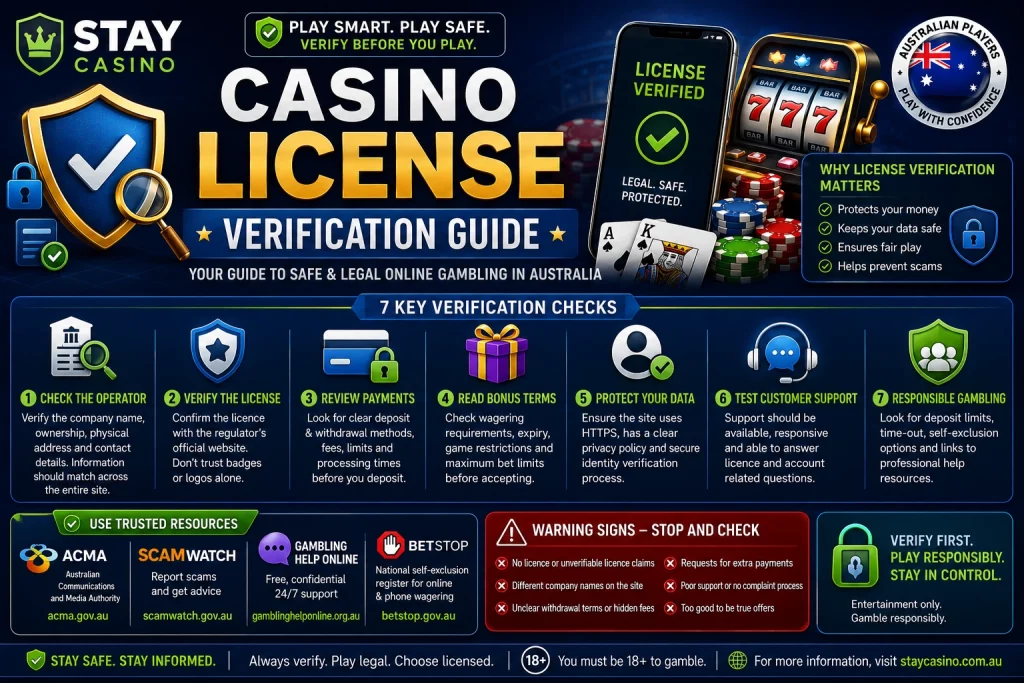
If the site hides ownership or uses vague wording such as “internationally trusted,” “global licence,” or “certified casino” without verifiable details, users should stop. A licence claim is only useful if it can be checked through an official source.
ACMA publishes information about blocked illegal gambling websites, and its blocked-site list exists because illegal gambling and affiliate websites continue trying to reach Australian users.
Check Account Access and Login Safety
The Login area is one of the first places where a user can detect risk. A safer platform should use HTTPS, show the correct domain, avoid suspicious redirects, and offer secure account recovery. Users should never enter passwords into pages reached through unexpected emails, SMS messages, social media posts, or pop-up ads.
A suspicious login page may imitate a real brand. It may use copied logos, similar colours, or a near-identical domain name. The safest approach is to check the address carefully and avoid entering credentials when the page feels unfamiliar or rushed.
Read Bonus Terms Before Trusting Any Offer
A Bonus page can reveal whether the website is transparent or manipulative. Unsafe operators often use large rewards, urgent countdowns, vague wording, or unrealistic claims to create pressure. A responsible information page should explain that promotional terms are not proof of legitimacy.
Users should check whether the offer has clear rules: wagering requirements, expiry dates, restricted games, maximum bet limits, withdrawal caps, and verification conditions. If the site hides these terms or shows them only after registration, that is a warning sign.
Be Careful Before Any Sign-Up
The Sign up process should never happen before a user understands who controls the site and how personal data will be handled. Registration may involve name, email, phone number, date of birth, address, device information, payment details, or identity documents.
A suspicious platform may ask for too much information too early, or it may request documents through informal channels. Users should not upload identity files unless the operator is clearly identified and the verification process is secure.
Scamwatch warns that scammers create fake gambling apps and websites promising sign-up deals, referral bonuses, and returns, but victims may lose money and receive no winnings.
| Verification Step | What to Check | Warning Sign |
|---|---|---|
| Operator identity | Company name, ownership details, jurisdiction, and complaint route | No company name, vague offshore wording, or copied footer text |
| Licence claim | Whether the provider appears on an official Australian register where relevant | Fake-looking badge, broken regulator link, or unverifiable licence number |
| Account access | Secure login, correct domain, HTTPS, and safe password reset | Unexpected redirects, browser warnings, or copied login screens |
| Promotion terms | Clear bonus conditions before any account action | Guaranteed win claims, hidden restrictions, or pressure to act quickly |
| Registration safety | Privacy policy, secure forms, and clear data-use explanation | Document requests before ownership or privacy details are clear |
App Verification and Mobile Risks
A gambling-related App can create additional risk because it may access device data, notifications, stored passwords, payment tools, and identity files. Fake apps can imitate real brands while collecting user information or redirecting payments.
Users should avoid unofficial app downloads, direct file links, social media downloads, or mirror sites. A safer mobile experience should use encrypted communication, minimal permissions, and clear privacy rules.
Mobile access can also increase behavioural risk because gambling becomes easier to start impulsively. This is why verification, privacy, and responsible gambling controls should be visible on mobile as well as desktop.
Game Pages Are Not Proof of Legitimacy
Attractive Slots pages or other Games pages do not prove that a platform is licensed or fair. Unsafe websites can copy game artwork, provider names, jackpot claims, and demo-style interfaces.
Users should check whether game rules, provider details, account records, and fairness explanations are clear. If the website cannot explain how games are supplied, tested, or recorded inside the account, it should not be trusted.
FAQ and External Safety Resources
A useful FAQ section should answer questions about licensing, payments, withdrawals, verification, privacy, account closure, complaints, and responsible gambling. If the FAQ only promotes deposits or offers, it is not a strong safety resource.
External Links should point toward recognised safety and regulatory resources. ACMA provides guidance for checking whether a gambling operator is legal, Scamwatch provides scam reporting and advice, and BetStop provides national self-exclusion from licensed Australian online and phone wagering providers.
Why Licence Badges Can Be Misleading
Licence badges are easy to copy. A suspicious gambling-related website may display regulator logos, “verified casino” seals, payment icons, fairness certificates, or award graphics without proving that any of them are real. This is why users should never treat a badge as evidence by itself.
A legitimate licence claim should be verifiable. The website should provide the operator name, licence number where applicable, jurisdiction, regulator name, and supporting terms that match the same company. If the footer shows one company name but the privacy policy shows another, users should treat that inconsistency as a serious warning sign.
For Australian users, the safest approach is to compare the website’s claims with official sources. A claim made by the gambling site is not enough. It must be supported by information that can be checked outside the site itself.
Match the Company Name Across the Website
One practical verification step is checking whether the same company name appears consistently across the website. Review the footer, terms and conditions, privacy policy, payment page, responsible gambling section, complaints page, and support replies.
A legitimate website should not show different operator names in different sections. If the terms name one company, the privacy policy names another, and support gives a third name, the platform may be copied, poorly managed, or intentionally misleading.
Users should also check dates. Old terms, outdated copyright years, broken regulator links, and references to unrelated brands suggest weak operational control.
| Licence Verification Area | What Should Match | Risk If It Does Not Match |
|---|---|---|
| Footer details | Company name, licence reference, jurisdiction, and contact information | The platform may be hiding ownership or using copied text |
| Terms and conditions | Same operator name as footer and registration flow | Disputes may become difficult to resolve |
| Privacy policy | Same data controller and contact route | Personal data handling may be unclear |
| Payment page | Payment entity should align with the stated operator or processor explanation | Money may be routed through unclear third parties |
| Support responses | Support should confirm the same legal and account information | Vague answers may indicate poor accountability |
Check Whether the Product Is Actually Covered
A licence is not always universal. A company may be authorised for one gambling product but not another. A licence for sports wagering, lotteries, or racing does not automatically prove that every casino-style product on a site is authorised for Australian users.
This point matters because some websites use broad licence language to create confidence. Users may see a licence badge and assume it covers everything on the platform. A safer review asks a more precise question: does the stated authorisation match the product being offered?
If a platform offers casino-style products but cannot explain how those products fit its licence and legal market, users should avoid it.
Verify the Registration Flow Before Sharing Data
A licence claim should be reviewed before account creation. Users should not begin registration just to see basic legal information. A trustworthy website provides licence, ownership, privacy, and payment details before asking for personal information.
During registration, users should check whether the domain remains stable and secure. If the page redirects to unrelated addresses, asks for unusual personal details, or shows inconsistent branding, the process should be stopped.
A legitimate registration journey should be predictable. It should not pressure users to deposit immediately, upload documents without explanation, or accept promotional terms before seeing full conditions.
Review Payment Rules Alongside Licence Claims
Payment transparency is closely connected to legitimacy. Even if a site claims to be licensed, users should still check deposit rules, withdrawal rules, verification requirements, fees, processing times, and complaint procedures.
A legitimate platform should not hide payment restrictions behind promotional language. Users should know how withdrawals work before any money is deposited.
If the platform promises fast withdrawals but the terms contain broad clauses allowing long delays without explanation, that should reduce trust.
Why Support Testing Matters
Support can help confirm whether licence claims are meaningful. Before sharing data or money, users can ask support direct questions:
Which company operates this website?
Which licence applies to this service?
Where can users verify the licence?
What products are covered?
How are complaints handled?
What responsible gambling tools are available?
A legitimate support team should provide clear answers or direct users to the correct policy pages. If support avoids the question, pushes registration, or gives generic replies, users should treat the site as higher risk.
How Licence Verification Reduces Scam Exposure
Licence verification is not only a legal check. It also reduces exposure to scams. Fake operators often depend on users acting quickly. They use offers, urgency, countdown timers, and copied trust badges to prevent careful review.
A slow verification process protects the user. Checking ownership, licence claims, payment rules, privacy policies, and support quality creates distance between curiosity and financial risk.
The safest users are not the ones who trust the best-looking website. They are the ones who verify before acting.
Comparing Verification Signals
Responsible Gambling Tools as a Licence Quality Signal
Licence verification should also include responsible gambling review. A safer platform should provide deposit limits, time limits, cooling-off periods, self-exclusion information, account closure options, and support resources.
If responsible gambling tools are hidden, unclear, or difficult to activate, users should question the platform’s overall standards. Player protection is part of operational legitimacy.
A licence claim without practical player-protection tools is not enough to establish trust.
Why Licence Checks Should Include Privacy Review
A casino licence claim should never be checked in isolation. A website may display licensing information, but users should also review how the platform handles personal data, payments, identity documents, account records, and marketing permissions. A legitimate gambling-related platform should show both legal accountability and responsible data handling.
Privacy matters because gambling websites may collect sensitive information during registration, verification, payments, support contact, and account closure. This can include full name, date of birth, address, phone number, email, payment method details, identity documents, transaction history, device information, and gambling activity.
A platform that cannot explain how personal information is collected, stored, shared, protected, and retained should not be trusted, even if it claims to hold a licence. Real verification means checking the full safety structure, not only the footer badge.
Privacy Policy Consistency
The privacy policy should match the operator details shown elsewhere on the website. If the licence section names one company, the terms name another, and the privacy policy refers to an unrelated brand, users should treat this as a serious warning sign.
A strong privacy policy should explain who controls user data, why information is collected, how long it may be stored, which third parties may receive it, and how users can ask questions or raise complaints.
Copied privacy policies are common on unsafe websites. Signs of copied text include wrong company names, references to unrelated jurisdictions, broken contact emails, outdated dates, and generic wording that does not match the actual service.
| Privacy Verification Point | What to Check | Warning Sign |
|---|---|---|
| Data controller | The named company should match the operator and licence details | Different company names appear in different sections |
| Data collection | The policy explains what personal, payment, device, and account data is collected | Vague wording with no practical explanation |
| Third-party sharing | Payment processors, identity providers, analytics, and support tools are described | No explanation of who may access sensitive data |
| Document handling | Verification uploads, storage, access, and retention are explained | Documents are requested without secure process details |
| Marketing control | Users can opt out of promotional communication | Promotions continue after opt-out or exclusion request |
Identity Verification and Licence Credibility
Identity verification can be a legitimate part of gambling compliance, but the process should be predictable and secure. A safer platform explains which documents may be required, why they are needed, how they should be uploaded, how long review may take, and what happens after verification is complete.
Users should avoid platforms that request documents through social media messages, personal email addresses, informal chat windows, or unclear third-party links. Sensitive documents should be submitted only through secure official channels.
Licence credibility decreases when verification feels improvised. Repeated document requests, changing explanations, vague support replies, or unclear data retention rules suggest weak operational control.
Payment Entity and Licence Alignment
Payment pages can reveal whether a platform is operating consistently. The payment entity should make sense when compared with the operator name, licence information, and terms. Sometimes payment processors or third-party providers are used, but their role should be explained clearly.
Users should be cautious if payment pages redirect to unrelated domains, show unfamiliar company names, request manual transfers, or provide no transaction record. Payment confusion often becomes a major problem during withdrawals.
A legitimate platform should make deposits and withdrawals transparent before any funds are sent. Licence verification should always include payment verification.
Responsible Gambling Requirements
Responsible gambling tools are an important part of legitimacy. A platform that claims to be serious about compliance should provide clear access to safer gambling features. These may include deposit limits, time reminders, cooling-off periods, self-exclusion options, account closure, support contacts, and information for people affected by gambling harm.
If these tools are hidden or difficult to activate, users should question the platform’s standards. A licence claim should be supported by practical player protection.
For Australian users, BetStop is a key national self-exclusion resource for licensed Australian online and phone wagering providers. A safer information page should direct people toward support and exclusion tools when gambling feels difficult to control.
Complaint Handling and Dispute Transparency
Licence verification should also include complaint review. A legitimate platform should explain how users can raise disputes about payments, verification, account restrictions, bonus terms, privacy, or support failures.
The complaint process should be written clearly. It should not rely only on temporary live chat messages. Users should be able to keep written records and understand expected response timeframes.
If no complaint process exists, or if support refuses to explain escalation steps, users should not trust the platform with money or documents.
User Feedback and Repeated Complaint Patterns
User feedback should not be followed blindly, but patterns matter. A single negative review may be inaccurate or emotional. Repeated reports of the same issue across different sources are more meaningful.
Common patterns to watch include delayed withdrawals, unclear verification, locked accounts after wins, ignored complaints, copied licence claims, changing terms, fake reviews, and suspicious payment redirects.
A complete licence verification review combines official checks, website consistency, privacy analysis, payment transparency, support quality, and user complaint trends.
Why Visual Trust Is Not Enough
A website may use official-looking seals, polished icons, security graphics, award badges, or “verified” labels. These visual elements are not proof. They must be supported by verifiable information.
Real legitimacy is shown through consistency and accountability. The operator name should match across pages. Licence details should be checkable. Payment rules should be clear. Privacy policies should be specific. Support should answer direct questions. Responsible gambling tools should be easy to find.
If the website looks professional but avoids basic verification questions, the risk remains high.
Why the Final Check Should Happen Before Any Account Action
Casino licence verification should happen before registration, payment, document upload, bonus acceptance, or account use. Once a user has shared personal information or sent money, it becomes harder to control the situation if the platform later appears unsafe.
A safe verification process should be slow, careful, and evidence-based. Users should not rely on design, testimonials, bonus banners, or trust badges alone. The strongest checks are ownership consistency, legal clarity, payment transparency, privacy protection, support quality, responsible gambling tools, and official resource comparison.
If any part of the website feels unclear, rushed, inconsistent, or difficult to verify, the safest action is to stop. A legitimate operator should make trust easy to check before asking users for money or documents.
Complete Licence Verification Table
| Final Verification Step | What Users Should Confirm | Stop Immediately If |
|---|---|---|
| Operator identity | The same company name appears in the footer, terms, privacy policy, payment area, and support replies | Different company names appear across the website |
| Licence details | The licence claim is specific, verifiable, and relevant to the product being offered | The site uses only vague badges or unverifiable licence wording |
| Payment transparency | Deposits, withdrawals, fees, limits, verification, and processing times are explained before payment | Withdrawals are unclear, delayed, or require extra release payments |
| Privacy and documents | Identity verification uses a secure upload process and clear data-handling rules | Documents are requested through unsafe chat, social media, or unclear email channels |
| Responsible gambling | Limits, cooling-off, self-exclusion, account closure, and support resources are easy to find | Player protection tools are hidden, delayed, or missing |
Compare Licence Claims With Official Sources
Users should never rely only on what a gambling website says about itself. A licence claim should be compared with official sources, regulator information, blocked-site warnings, scam reporting resources, and independent complaint patterns.
For Australian users, official regulatory context matters because online gambling rules are strict. A website may be accessible from Australia, but access does not automatically mean the service is legal, protected, or suitable for Australian users.
When checking external sources, users should look for matching company names, domain names, regulator references, complaint history, and enforcement warnings. If the website claims one identity but official sources show another, users should avoid the platform.
Licence Verification Confidence Over Time
Watch for Licence Verification Traps
Unsafe websites often use the appearance of verification without providing real verification. This may include licence numbers that cannot be checked, broken regulator links, copied seals, fake “certified” labels, and unclear ownership statements.
Another common trap is mixing real and misleading information. A site may list a real regulator but not show that the specific operator or product is covered. It may mention a legitimate company while payments are routed through unrelated entities. It may show responsible gambling text copied from another site without offering actual limit tools.
These details matter. A legitimate platform should not require users to guess which parts of its compliance story are real.
Payment and Withdrawal Review Before Trust
Payment review is one of the strongest final checks. Users should read withdrawal rules before depositing. They should also confirm whether bonus activity affects withdrawals, whether identity checks are required, and whether processing timeframes are realistic.
If the platform makes deposits easy but withdrawals vague, trust should fall immediately. A legitimate operator should not create new payment conditions only after a user requests funds.
Users should avoid any platform that asks for extra money to unlock withdrawals. Requests for release fees, clearance fees, tax payments, VIP upgrades, or verification charges are major risk signals.
Support Testing Before Sharing Documents
Before uploading identity files, users should test support with direct questions. Ask who operates the website, which licence applies, how documents are stored, how withdrawals work, how complaints are handled, and how account closure is requested.
Support does not need to be perfect, but it should be specific and consistent. Vague replies, copied answers, pressure to deposit, or refusal to explain basic rules are serious warning signs.
Document sharing should happen only when the operator is clear, the upload process is secure, and the privacy policy explains how files are handled.
User Feedback and Pattern Recognition
User feedback can support licence verification when it is read carefully. One complaint does not prove a site is unsafe, and one positive review does not prove legitimacy. Repeated patterns matter more.
Users should pay attention to recurring reports of delayed withdrawals, hidden terms, changing verification demands, locked accounts after wins, missing support replies, copied licence claims, payment redirects, and unresolved privacy complaints.
If several sources describe the same issue, users should treat the pattern as evidence of operational risk.
When Verification Fails
If licence verification fails, users should not continue. They should not register, deposit, claim offers, download apps, upload documents, or enter payment details. The safest action is to leave the platform and use official safety resources if needed.
If a user has already shared payment details or identity documents, they should secure accounts, change reused passwords, contact their bank or payment provider if necessary, save evidence, and report suspicious activity through relevant Australian channels.
Early refusal is the strongest protection. It prevents the user from having to recover money, repair identity exposure, or resolve disputes with an unclear operator.
Final Advice for Stay Casino Readers
Casino licence verification is not about finding the most attractive platform. It is about avoiding illegal, unsafe, unclear, or poorly managed gambling-related websites. A legitimate operator should prove who it is, how it is regulated, how it protects data, how payments work, and how users can get help.
For Stay Casino readers, the final rule is simple: trust evidence, not appearance. If the licence cannot be verified, the company name is inconsistent, withdrawal rules are vague, support avoids questions, or responsible gambling tools are missing, the safest decision is to stop immediately.
A real safety check protects money, identity, privacy, and wellbeing before risk begins.






Comments