
How to Identify Legit Casino Australia
Why Legitimacy Checks Matter in Australia
Identifying a legitimate casino-related website in Australia requires more than looking at design, bonuses, game graphics, or fast registration pages. A site may appear polished and professional while still creating legal, financial, privacy, or consumer-protection risks. For Australian users, the most important question is not simply whether a gambling website works, but whether it operates transparently, legally, securely, and responsibly.
Australia has a strict online gambling environment. ACMA explains that the Interactive Gambling Act prohibits certain online gambling services being provided to people in Australia, including online casinos and some other interactive gambling products. ACMA can investigate and take enforcement action against prohibited or unlicensed services, including website blocking.
This means a website being accessible from Australia does not automatically make it legitimate for Australian users. Some offshore operators may still appear through search engines, social media, mirror domains, or affiliate pages. Accessibility is not the same as compliance.
For Stay Casino readers, the safest approach is to treat every unfamiliar gambling-related site as unverified until it proves otherwise. A legitimate platform should make ownership, legal status, security, privacy, payments, terms, responsible gambling tools, and support information easy to check.
Check Licensing and Legal Status First
The first legitimacy check is licensing. A trustworthy gambling-related website should clearly identify the company that operates it, the jurisdiction where it is licensed, the licence number where applicable, and the regulator responsible for oversight.
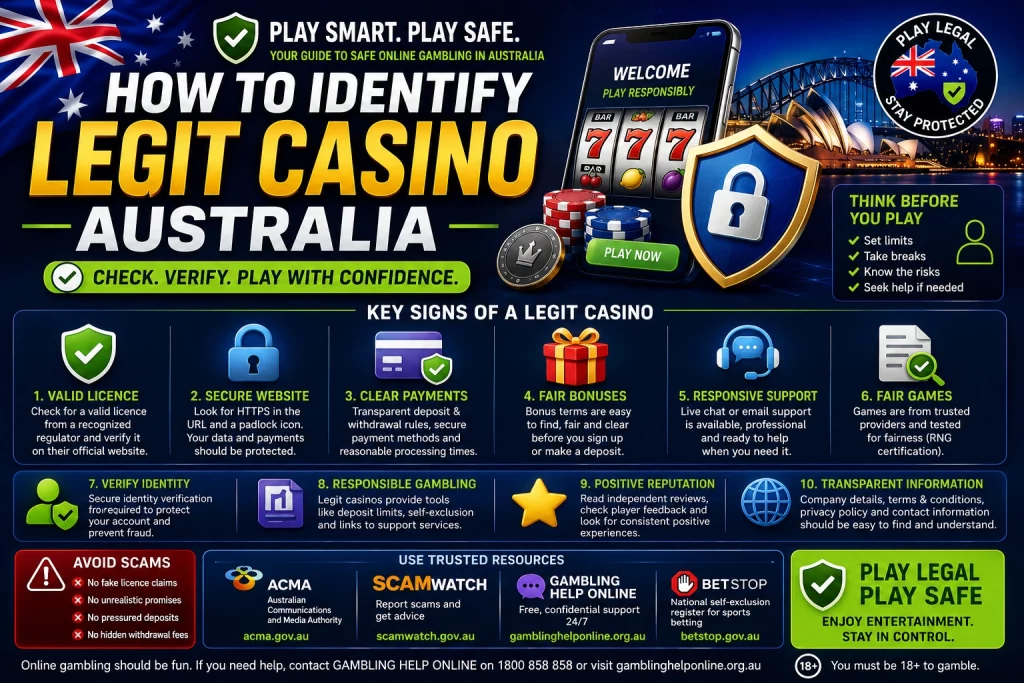
If a website only says “fully licensed,” “internationally regulated,” or “trusted worldwide” without giving verifiable details, that is not enough. A vague badge or copied logo does not prove legitimacy. A player should be able to compare the site’s claims with official regulator information.
ACMA maintains information about blocked illegal gambling websites and enforcement activity. Its blocked website list exists because some illegal gambling and affiliate sites continue trying to reach Australian users despite regulatory action.
A legitimate site should not hide from regulation. It should explain who owns it, what rules apply, how complaints are handled, and what protections are available to users.
Review the Login Page Carefully
The Login page is a major trust point because it collects account credentials. A legitimate website should use HTTPS, display the correct domain, avoid suspicious redirects, and provide secure password recovery.
A fake or unsafe login page may imitate a real brand to collect passwords. It may arrive through promotional emails, social media messages, or fake support links. Users should avoid entering credentials after clicking unexpected messages. The safer habit is to open the site through a trusted address and check the domain manually.
Legitimacy is partly technical and partly behavioural. Even a site with a secure-looking page should be avoided if ownership, licensing, and support details are unclear.
Understand Bonus Transparency
The Bonus section can reveal whether a platform is transparent or manipulative. A legitimate operator should show clear terms before any offer is accepted. These terms should include wagering requirements, expiry dates, maximum bet rules, withdrawal restrictions, game contribution rules, eligibility, and verification conditions.
Unclear bonus terms are a common source of disputes. A site that advertises large rewards but hides conditions until after deposit activity is not operating transparently.
A legitimate promotional page should not pressure users to act immediately. Urgency, countdown timers, guaranteed profit claims, and “risk-free” language should be treated with caution.
Registration Should Be Clear and Safe
The Sign up process should be structured, secure, and transparent. A legitimate site explains what personal information is collected, why it is needed, how it is protected, and whether identity checks may be required.
Registration should not demand excessive personal information before showing privacy rules or terms. Users should be able to read account conditions, payment rules, verification requirements, and responsible gambling information before submitting sensitive details.
BetStop, Australia’s National Self-Exclusion Register, also highlights that licensed Australian online and phone wagering providers must not let registered self-excluded people place bets, open new betting accounts, or receive marketing messages. This is one reason legitimate operators should take identity, exclusion, and account checks seriously.
| Legitimacy Check | What a Legit Site Should Show | Warning Sign |
|---|---|---|
| Legal status | Clear ownership, licence details, regulator information, and compliance notes | Vague claims, fake-looking badges, or no operator identity |
| Account access | Secure login page, HTTPS, correct domain, safe password reset | Suspicious redirects, browser warnings, or copied login pages |
| Promotion terms | Bonus rules visible before deposit or participation | Hidden wagering rules, unrealistic rewards, or urgent pressure |
| Registration | Secure forms, privacy policy, age checks, and clear verification rules | Excessive data requests before terms are shown |
| Responsible gambling | Limit tools, self-exclusion information, support contacts, and account closure options | Tools are hidden, vague, or difficult to activate |
Mobile App Legitimacy
A gambling-related App should be treated carefully. Fake apps can collect login details, payment data, device information, or identity files. A legitimate app should come from an official source, use encrypted communication, avoid unnecessary permissions, and match the operator’s stated privacy policy.
Users should avoid downloading apps from direct file links, social media messages, unknown mirrors, or unofficial pages. A suspicious app may request unrelated permissions, crash frequently, redirect payments oddly, or display different branding from the website.
Mobile access can also increase behavioural risk because gambling becomes easier to start impulsively. A legitimate platform should provide mobile responsible gambling tools, not only fast access.
Game Transparency and Fairness
A legitimate platform should explain how Slots and other Games work. It should provide rules, game providers, payout information where relevant, and fairness or testing references when available.
Fairness does not mean players are likely to win. It means games should operate according to stated rules. A legitimate platform should not hide rules, change outcomes, or provide unclear balance records.
If game pages have no rules, no provider information, no support explanation, and no account history, users should treat that as a serious legitimacy concern.
FAQ and Support Pages
A legitimate FAQ section should answer practical safety questions. It should explain registration, verification, payments, withdrawals, account security, privacy, responsible gambling tools, complaints, and account closure.
Useful Links should lead to official safety resources, regulator information, support services, privacy guidance, and responsible gambling tools. A site that only links to promotions or deposits is not giving users enough safety information.
Why Payments Reveal Whether a Casino Is Legit
Payment transparency is one of the strongest ways to identify whether a casino-related website is legitimate. A site may look professional, display security badges, and advertise attractive offers, but payment handling shows how the operator actually treats users.
A legitimate platform should explain deposits, withdrawals, fees, processing times, identity checks, payment ownership requirements, and rejected withdrawal reasons before the user adds money. If this information is hidden or difficult to understand, trust should decrease.
Australian users should be especially careful with platforms that make deposits instant but withdrawals slow, unclear, or conditional on repeated extra steps. A safe platform does not need to make cashout rules confusing.
Withdrawal Rules Should Be Clear Before Deposit
A legit casino-related website should publish withdrawal rules in plain language. Users should be able to find minimum and maximum withdrawal amounts, expected processing periods, accepted payout methods, verification requirements, and support contacts for payment problems.
If withdrawal rules appear only after a user wins or requests a cashout, that is a warning sign. Legitimate payment systems are predictable.
A platform should also explain whether bonus activity affects withdrawals. If promotional funds, wagering conditions, or restricted games can affect a cashout, those rules should be visible before the user accepts the offer.
| Payment Check | Legit Casino Standard | Risk Signal |
|---|---|---|
| Deposit information | Minimums, methods, fees, and currency details are visible | Only deposit buttons are shown, with no clear terms |
| Withdrawal policy | Processing times, limits, and conditions are explained | Rules appear only after a cashout request |
| Verification timing | Document requirements are explained early | New requirements appear repeatedly after withdrawal |
| Payment ownership | The platform checks account and payment method consistency | Requests are unclear, excessive, or unsafe |
| Support records | Payment questions receive specific written answers | Support gives vague replies or avoids timelines |
Verification Should Protect the User, Not Trap Them
Identity verification is normal in many regulated gambling and financial environments. It can help prevent underage access, stolen identity use, fraud, duplicate accounts, and payment misuse.
However, verification should not become a trap. A legitimate site explains what documents may be needed, why they are required, how they should be uploaded, and how long review usually takes.
Users should be cautious if verification requests change repeatedly without explanation. They should also avoid sending identity documents through social media, informal chat, or unverified email addresses.
A secure upload portal and clear privacy policy are basic expectations.
Customer Support Should Be Testable
Before trusting a platform, users should test support. Ask simple questions: How long do withdrawals take? What documents are required? How can I close my account? How do limits work? Where is the privacy policy? What happens if a payment fails?
A legitimate support team should answer clearly. It may not resolve every issue instantly, but it should provide useful, consistent, and professional information.
Poor support is not only inconvenient. It may indicate deeper operational weakness. If support avoids basic questions before a deposit, it may be worse after a dispute.
Complaint Handling and Dispute Resolution
Legitimate gambling-related platforms should provide a complaint process. Users should know how to raise a payment issue, verification complaint, account dispute, or privacy concern.
A complaint process should not rely only on temporary chat messages. Written records matter. Users should save screenshots of terms, payment pages, support conversations, transaction IDs, account balances, and withdrawal requests.
If a platform refuses to explain complaint steps, it should be treated as higher risk.
Payment Method Safety
Some payment methods provide stronger records and user protections than others. Legit platforms generally explain payment routes clearly and do not pressure users into unusual transfers.
Users should be cautious if a site pushes cryptocurrency, gift cards, personal bank transfers, or manual payments without transparent terms. These methods may be difficult to reverse or dispute.
A legitimate platform should not demand additional payments to release winnings. Requests for “tax,” “clearance,” “unlocking,” “VIP upgrade,” or “verification release” fees are serious warning signs.
How Payment Confidence Builds
Privacy and Payment Data Protection
Payment information is sensitive. A legitimate platform should protect personal and financial data through encrypted pages, secure processors, access controls, and a clear privacy policy.
Users should understand what data is collected during payment activity and whether third-party processors are involved. If payment pages redirect to unknown websites or show browser warnings, the user should stop.
Payment safety also includes transaction visibility. The user should be able to review deposit history, withdrawal requests, pending transactions, and account balance changes.
Responsible Gambling Tools Around Payments
A legit platform should connect payment activity with responsible gambling tools. Deposit limits, loss limits, session reminders, cooling-off periods, and self-exclusion options help prevent financial harm.
If a user increases deposits frequently, loses control of spending, or uses gambling to solve money pressure, the safest step is to stop and use support services.
A legitimate casino-related environment should make harm-prevention tools easy to find, not hidden behind promotional pages.
Why Technical Security Is Part of Legitimacy
A legitimate casino-related website should protect user information through visible technical security. This includes HTTPS encryption, secure account access, protected payment pages, safe document upload, and privacy controls. Security does not prove everything about a platform, but weak security is a serious warning sign.
Users should never enter passwords, payment details, or identity documents on pages that show browser warnings, suspicious redirects, or unsecured connections. A site that cannot protect basic account access should not be trusted with sensitive personal information.
Security should also apply across the full account journey. Registration pages, cashier pages, support forms, verification portals, and account dashboards should all be protected. If only the homepage appears secure while sensitive pages behave strangely, the risk remains high.
Fair Game Information
A legitimate platform should provide clear game information. Users should be able to see rules, paytable details, game providers, possible limits, and responsible gambling information connected to the product.
Fairness does not mean guaranteed profit. It means the game should operate according to stated rules. A legitimate platform should not hide game mechanics, change balances without explanation, or provide unclear session records.
If game pages are vague, incomplete, or disconnected from account records, users should treat that as a trust problem.
| Legitimacy Signal | What It Should Show | Why It Matters |
|---|---|---|
| HTTPS security | Encrypted connection across login, registration, payments, and verification | Protects sensitive data during account use |
| Game rules | Clear rules, provider details, paytable information, and product limits | Helps users understand risk before playing |
| Account history | Visible deposits, withdrawals, balance changes, and session records | Supports transparency and dispute resolution |
| Privacy policy | Clear explanation of data collection, storage, sharing, and retention | Shows how personal information is handled |
| Responsible gambling tools | Deposit limits, time limits, cooling-off, self-exclusion, and support contacts | Protects users when gambling becomes risky |
Responsible Gambling Tools as a Legitimacy Test
Responsible gambling tools are not optional decoration. They are a core trust signal. A legitimate platform should provide practical tools that help users control gambling activity.
These may include deposit limits, session reminders, cooling-off periods, account closure, self-exclusion, and links to gambling support services. These tools should be easy to locate and activate.
If responsible gambling tools are hidden, delayed, or difficult to use, the platform is not prioritising player protection. A legitimate operator should make it easier to reduce risk, not harder.
Privacy Policy and Data Handling
A legitimate platform should explain how personal data is handled. This includes identity details, payment information, device data, transaction history, gameplay records, and support messages.
A privacy policy should identify who controls the data, what information is collected, why it is used, who it may be shared with, and how players can raise privacy questions.
Users should be cautious if the privacy policy is missing, copied, inconsistent, or references another company name. These mistakes may indicate poor operations or a copied scam site.
Customer Reviews and Complaint Patterns
Reviews can help, but they must be read carefully. One negative review does not prove that a platform is illegitimate. One perfect review also proves very little. The most useful information comes from repeated complaint patterns.
Common patterns include delayed withdrawals, unclear verification, locked accounts after wins, hidden bonus rules, ignored support, copied licence claims, and suspicious payment redirects.
If many users report the same problem across different sources, the risk is higher. A legitimate platform should not have repeated unresolved complaints about the same core issues.
Licence Badges and Fake Trust Icons
Some unsafe websites use fake badges to appear legitimate. These may include regulator logos, payment provider logos, testing seals, award icons, or “verified” marks.
A real badge should be verifiable. If a badge does not link to an official source or cannot be confirmed elsewhere, it should not influence trust.
Users should remember that visual design is easy to copy. Evidence matters more than graphics.
Support Testing Before Deposit
A practical legitimacy test is to contact support before depositing. Ask about withdrawals, verification, account closure, deposit limits, privacy, and responsible gambling tools.
A legitimate support team should give clear answers. If support avoids questions, pushes deposits, gives generic replies, or refuses to explain terms, users should not continue.
Support quality becomes especially important when disputes happen. If the platform is weak before a problem, it is unlikely to improve after money is involved.
Regulatory and Support Resources
Australian users should rely on recognised resources when checking online gambling risk. ACMA provides information about illegal online gambling services and website blocking. Scamwatch provides scam awareness and reporting tools. Gambling Help Online and BetStop provide harm-prevention support.
Using official resources helps users avoid relying only on promotional reviews or affiliate rankings.
Why the Final Check Should Happen Before Any Deposit
The safest time to identify whether a casino-related website is legitimate is before depositing money, uploading documents, accepting promotions, or storing payment details. Once personal data or funds are shared with an unsafe platform, the situation becomes harder to control.
Australian users should treat legitimacy checking as a structured process. A site should prove transparency before asking for trust. It should explain who operates the platform, what legal framework applies, how payments work, how user data is protected, how disputes are handled, and what responsible gambling tools are available.
A legitimate platform does not hide basic information. It does not rely only on large banners, glossy design, fast registration, or aggressive promotional language. It provides clear evidence that users can review before making decisions.
| Final Check | What a Legit Casino Should Provide | Stop If You See This |
|---|---|---|
| Operator identity | Clear company name, ownership details, and contact information | No company name, vague offshore wording, or anonymous ownership |
| Legal and regulatory information | Verifiable licence details, terms, and compliance information | Fake-looking badges, broken regulator links, or missing licence data |
| Payment transparency | Clear deposit, withdrawal, fee, limit, and verification rules | Hidden cashout conditions, surprise fees, or extra release payments |
| Security and privacy | HTTPS, privacy policy, secure document upload, and data handling rules | Browser warnings, unsafe document requests, or copied privacy text |
| Player protection | Responsible gambling tools, account closure, limits, and support resources | Tools are hidden, delayed, or difficult to activate |
Check the Whole User Journey
A platform should not be judged only by its homepage. Users should review the complete journey: registration, account access, payments, verification, game rules, support, responsible gambling tools, privacy controls, and account closure.
Some unsafe sites appear convincing at the beginning but become unclear when money is involved. Others show problems only during withdrawal, identity verification, or support disputes. This is why each stage should be checked before committing funds.
A legitimate site should remain consistent from start to finish. The same company name should appear in the footer, terms, privacy policy, payment pages, and support replies. If different names, jurisdictions, or rules appear in different sections, that is a warning sign.
Look for Operational Consistency
Legitimate platforms usually maintain consistency across content, systems, and support. Their terms match their promotional pages. Their payment rules match support explanations. Their privacy policy matches their verification process. Their responsible gambling section matches the tools available inside the account.
Operational inconsistency is a major risk signal. If support says one thing and terms say another, users may face disputes later. If the payment page lists one timeframe but support gives a different one, withdrawal reliability becomes uncertain.
Consistency matters because it shows that the platform has organised systems rather than improvised rules.
Review User Feedback Patterns
User reviews should be treated carefully. A single complaint does not prove a platform is illegitimate, and a single positive review does not prove safety. The most useful evidence is repeated patterns across several sources.
Repeated reports of delayed withdrawals, unclear verification, locked accounts after wins, ignored complaints, hidden bonus rules, fake licence claims, suspicious redirects, or unsafe document requests should be treated seriously.
A legitimate platform may still receive complaints, but it should show signs of resolving them. Unresolved repeated complaints suggest operational weakness.
Legit Casino Confidence Over Time
Do Not Trust Pressure Tactics
A legitimate casino-related platform should not pressure users into fast decisions. Pressure tactics include countdown timers, urgent deposit prompts, “final chance” messages, guaranteed win claims, withdrawal release fees, or support agents pushing additional deposits.
Urgency is often used to stop users from checking details. The safer response is to pause, read terms, verify ownership, and avoid sharing payment or identity information until everything is clear.
Real trust does not require rushing.
Know When Not to Continue
The safest decision is sometimes to leave the site completely. If a platform cannot prove ownership, legal status, payment transparency, data security, fair terms, and responsible gambling protections, users should not continue.
This is especially important if gambling already feels stressful or difficult to control. A platform may be technically legitimate, but gambling can still become harmful. If spending, time, mood, or relationships are affected, support should come before further play.
Legitimacy checking protects against unsafe operators. Responsible gambling protects against personal harm. Both matter.
Final Advice on How to Identify Legit Casino Australia
To identify a legit casino-related website in Australia, users should check licensing, operator identity, legal status, secure login, transparent payments, fair bonus terms, safe verification, privacy protection, responsible gambling tools, and real support quality.
A legitimate platform should make these details visible before asking for money or documents. It should not hide behind vague badges, urgent promotions, copied reviews, or unclear terms.
The final rule is simple: trust evidence, not appearance. If the site cannot prove that it is transparent, secure, responsible, and accountable, it should not be treated as legitimate.






Comments