
Stay Casino Offline Casinos
Offline Casinos in Australia: General Information for Stay Casino Readers
Offline casinos are land-based gambling venues where casino-style activities take place in a physical location rather than through a website or mobile platform. In Australia, this distinction matters because land-based gambling and online gambling are regulated through different legal and operational frameworks. A physical casino may operate under state or territory licensing rules, while online gambling services are also affected by federal rules such as the Interactive Gambling Act 2001.
For Stay Casino readers, the topic of Offline Casinos should be treated as an informational comparison, not as a recommendation to visit or use gambling venues. The main purpose of this page is to explain how offline casinos differ from online casino-style websites, what users should understand about regulation, payments, identity checks, responsible gambling tools, and why legal status should never be assumed from appearance alone.
ACMA explains that the Interactive Gambling Act 2001 makes it illegal for gambling providers to offer certain online gambling services to people in Australia, including some online casino-style services. This is why a physical casino environment and an online casino-style website should not be treated as the same thing.
Offline Casinos vs Online Casino-Style Websites
The biggest difference between offline casinos and online casino-style websites is the operating environment. Offline casinos exist in physical venues. They usually have visible premises, staff, venue rules, security systems, local licensing obligations, and direct entry controls. Online casino-style websites operate remotely through websites or apps, and users may not always know who controls the platform, where it is based, or whether it is allowed to offer services to Australian users.
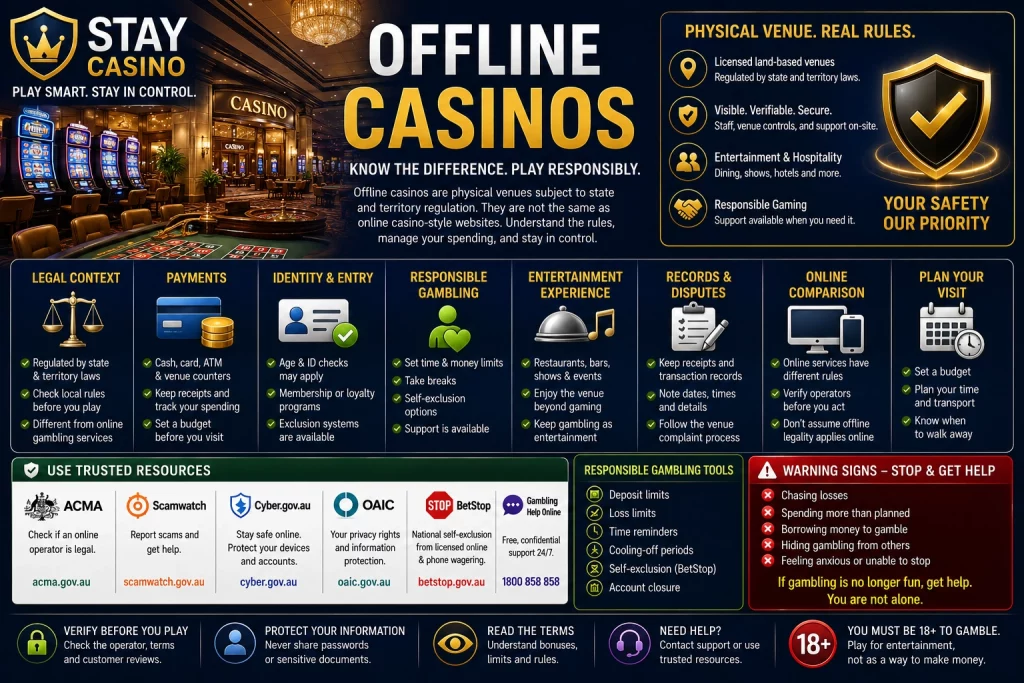
This distinction affects trust. In a physical venue, users can see the location, entry rules, signage, staff, and responsible gambling information. Online, users must rely on legal disclosures, privacy policies, payment pages, support channels, and official regulatory checks.
That does not mean offline casinos are risk-free. Gambling harm, financial loss, and behavioural risk can exist in any gambling environment. The safer approach is to understand the differences before making assumptions.
Legal Structure and State-Level Regulation
Australia does not use one single gambling regulator for every gambling activity. Land-based gambling is commonly regulated at state and territory level, while online and phone gambling services are also shaped by federal law. This creates a layered system where venue type, product type, operator status, and location all matter.
A general information page should therefore avoid saying that one rule applies to everything. Offline casinos, online wagering, lotteries, poker machines, casino table games, and online casino-style products can sit under different rules. Users should check the relevant state, territory, or federal source before relying on any claim.
ACMA also provides a public way to check whether an online wagering operator is legal in Australia and says legal interactive wagering providers must appear on the register of licensed interactive gambling providers.
Why Offline Legality Does Not Prove Online Legality
One common misunderstanding is assuming that if casino-style activities exist in physical venues, similar online products must also be allowed. That assumption is unsafe. A physical venue may be licensed under local rules, while an online casino-style service may still be prohibited or unlicensed for Australian users.
This is especially important when users see websites using familiar casino visuals: roulette wheels, card tables, slot reels, jackpots, chips, live dealer imagery, or luxury venue-style branding. These visuals may resemble offline casinos, but they do not prove legal status.
ACMA warns that some illegal online gambling services can look legal and may target Australian players, while users may not receive the same customer protections as with licensed services.
| Comparison Point | Offline Casinos | Online Casino-Style Websites |
|---|---|---|
| Operating environment | Physical venue with visible location, staff, entry rules, and local controls | Remote website or app where ownership and location may be harder to verify |
| Regulatory context | Usually connected to state or territory gambling regulation | May involve federal online gambling rules and product-specific restrictions |
| Identity checks | May involve venue entry checks, membership systems, or staff-based controls | May request digital documents, account verification, and payment ownership checks |
| Payment visibility | Cash, card, or venue-based payment processes may be physically visible | Payments may involve processors, redirects, digital wallets, or unclear descriptors |
| Responsible gambling access | May include venue signage, staff assistance, exclusion options, and support information | Should include limits, self-exclusion, account closure, and support links, but quality varies |
Account Access and Digital Differences
Offline casinos usually do not depend on a digital account in the same way online platforms do. Online services often rely on a Login page, account dashboard, password recovery, payment history, and identity verification systems. These tools create extra privacy and cybersecurity considerations.
A user should never treat a login page as safe simply because the website looks similar to a physical casino brand. The domain, operator identity, privacy policy, and legal status all need to be checked first.
Promotions, Bonuses, and Offline Comparisons
Offline casinos may use loyalty programs, event offers, dining promotions, or venue-based rewards. Online sites may use a Bonus page with deposit offers, free spins, cashback-style wording, or loyalty campaigns. These formats look different, but the same principle applies: promotional language is not proof of safety.
A responsible information article should explain that users must read terms before acting on any offer. Expiry dates, wagering rules, eligibility limits, withdrawal restrictions, and account requirements can change the meaning of a promotion completely.
Registration and Visitor Information
Offline casinos may require entry checks, venue membership, or identification depending on local rules and venue policy. Online platforms usually use a Sign up process that can collect personal data such as name, email, phone number, date of birth, address, payment information, and identity documents.
This digital registration process creates different risks. If the operator is unclear or the privacy policy is vague, users should not share data. Identity documents should never be uploaded to an unclear platform or sent through informal channels.
Mobile Apps and Offline Casino Branding
Some casino-related brands may promote an App or mobile experience. Users should be careful with any app connected to gambling-style activity. A physical brand name does not automatically make a mobile app safe, legal, or appropriate for Australian users.
A safe review should check whether the app comes from an official source, whether the operator identity matches the website, whether privacy rules are clear, and whether responsible gambling tools are available inside the mobile experience.
Slots, Games, and Product Type Confusion
Offline casinos may contain poker machines, table games, electronic gaming areas, entertainment spaces, restaurants, and hotel facilities. Online websites may show Slots and other Games using similar visuals. The resemblance can create confusion.
The product type matters. Casino-style online products can raise different legal questions from land-based venue products. Users should not assume that a familiar game name, graphic style, or provider logo proves legal access online.
FAQ and Links as Education Tools
A strong offline casino information page should include a clear FAQ that explains the difference between land-based venues and online services, how legal status is checked, why responsible gambling tools matter, and how users can find support.
Useful Links should point to official resources and support services rather than only promotional pages. For Australian readers, ACMA, BetStop, Gambling Help Online, Scamwatch, Cyber.gov.au, and privacy resources can help users make safer decisions.
Responsible Gambling in Offline and Online Settings
Responsible gambling is relevant in both offline and online environments. A physical venue may provide signage, staff assistance, exclusion options, and support information. Online services should provide limits, cooling-off tools, account closure, self-exclusion information, and support contacts.
BetStop is Australia’s National Self-Exclusion Register for licensed Australian online and phone wagering providers, and once registered, users cannot place bets, open new betting accounts, or receive marketing messages from those providers.
Why Offline Casinos Feel More Transparent
Offline casinos can feel more transparent than online casino-style websites because they exist in a visible location. A visitor can see the building, staff, entry points, gaming areas, payment counters, responsible gambling signs, and support notices. This physical setting can create a stronger sense of structure and accountability.
However, visibility should not be confused with absence of risk. Offline casinos still involve gambling loss risk, time pressure, emotional decision-making, and spending control issues. A venue may be regulated and professionally managed, but the gambling activity itself still carries financial and behavioural risk.
For Stay Casino readers, the useful comparison is not “offline is safe and online is unsafe.” The better comparison is this: offline casinos and online casino-style websites create different types of risk, and users need different checks for each environment.
Payment Flow in Offline Casinos
Payment flow in offline casinos is usually more direct than online payments. A visitor may use cash, cards, ATMs, venue payment counters, or other approved payment services depending on the venue and local rules. The transaction happens in a physical space, and users may have immediate receipts or visible records.
Online casino-style websites can be less transparent because deposits and withdrawals may involve payment processors, redirects, wallets, digital accounts, foreign currency conversion, unclear merchant descriptors, or offshore entities. This does not mean every digital payment is unsafe, but it does mean the user needs more verification before acting.
In offline settings, users should still monitor spending. The physical environment can make gambling feel social or entertainment-based, but money can still be lost quickly. Spending limits should be decided before entering the venue, not during play.
Withdrawal Money and Cashout Differences
Offline casino cashout processes may involve cashier desks, ticket redemption, membership account balances, or venue-specific procedures. The user may receive physical proof of cashout or a direct receipt. Online platforms usually depend on account dashboards, withdrawal requests, verification status, support replies, and payment processing times.
This difference matters because disputes are documented differently. In an offline venue, evidence may include receipts, entry records, membership activity, or staff communication. Online, evidence may include screenshots, transaction IDs, support chat logs, email confirmations, and terms pages.
A general informational page should explain that users should keep records in both environments. Receipts, timestamps, screenshots, emails, and transaction statements help if anything becomes unclear.
| Practical Area | Offline Casino Context | Online Context |
|---|---|---|
| Payments | Cashier desks, cash, card use, ATMs, and visible venue procedures may apply | Payment processors, redirects, wallets, bank cards, and account dashboards may apply |
| Cashout records | Receipts, tickets, membership records, and venue transaction records may exist | Withdrawal IDs, screenshots, payment confirmations, and support messages are important |
| Identity checks | Entry control, age checks, membership checks, or staff verification may be used | Digital identity documents, address proof, and payment ownership checks may be requested |
| Responsible gambling tools | Venue signage, staff support, exclusion processes, and local help information may be visible | Deposit limits, cooling-off, account closure, self-exclusion links, and support pages should be available |
| Dispute path | Users may speak to venue staff or follow venue complaint procedures | Users often rely on support tickets, email records, complaint pages, and regulator information |
Visitor Controls and Identification
Offline casinos may use visitor controls such as age checks, identification requests, dress codes, entry rules, security screening, membership cards, or exclusion lists. These controls are part of the physical venue environment.
Online services rely more heavily on digital controls. A user may create an account, verify identity, confirm payment ownership, and pass automated account checks. This creates a different privacy profile because documents may be uploaded and stored digitally.
The key lesson is that identification works differently in each setting. Offline checks may happen face to face. Online verification can create longer-term data exposure if the operator is unclear or unsafe.
Responsible Gambling in Physical Venues
Responsible gambling in offline casinos may include visible signage, brochures, staff support, time reminders, exclusion options, and local support contact information. The physical environment may also provide more opportunities for a person to leave, speak with someone, or take a break away from the gaming area.
However, venues can still be stimulating environments. Lights, sound, crowds, alcohol availability, and the social atmosphere may make spending control harder for some people. A responsible visitor should set limits before arrival and leave when those limits are reached.
A strong informational page should make clear that responsible gambling tools are not only for online platforms. They are relevant in all gambling environments.
Offline Casinos and Entertainment Facilities
Many offline casinos are not only gambling venues. They may include restaurants, hotels, event spaces, bars, conference areas, shows, and tourism-related services. This can make the environment feel broader than gambling alone.
That mixed environment can be positive for people who treat the venue as entertainment, dining, or hospitality, but it can also blur spending decisions. A visitor may enter for a meal or event and still be exposed to gambling areas.
For a general article, it is useful to explain that offline casino venues combine hospitality and gambling. Users should understand which parts of the venue involve gambling risk and which parts are non-gambling entertainment.
Online Convenience vs Offline Friction
Offline casinos usually require travel, entry, time, and physical presence. Online casino-style websites and mobile apps reduce friction. A user can access gambling-style pages from home, at night, during stress, or through a mobile device.
This lower friction can increase behavioural risk. It becomes easier to make quick decisions, repeat deposits, and continue without social visibility. This is one reason why online platforms should provide strong limit tools, account closure options, and support links.
Offline environments have their own risks, but the friction of physical presence can sometimes slow behaviour. Online access can remove that delay.
Offline Casino Risk Awareness Chart
Why Offline Casino Rules Should Be Checked Locally
Because land-based gambling is often connected to state or territory regulation, users should check local rules rather than relying on general assumptions. Venue requirements may differ by location, product type, age verification, exclusion systems, payment rules, and complaint handling.
A general page should avoid giving venue-specific legal advice. Instead, it should explain the principle: offline casino rules depend on jurisdiction and venue licensing. Users should check official local sources if they need precise information.
This is especially important for people travelling between states or territories. A venue experience in one location may not match another.
Complaints and Venue Accountability
Offline casinos generally have venue-based complaint procedures. A visitor may speak with staff, request a manager, contact venue support, or follow a written complaints pathway. The exact process depends on the venue and local rules.
Users should keep records if they need to raise an issue. Receipts, membership activity, timestamps, written notes, names of departments, and copies of communication can help clarify what happened.
A responsible information page should tell users not to rely only on memory. Gambling environments can be busy, emotional, and fast-moving. Written records make disputes easier to explain.
Education as the Main Purpose
The Offline Casinos page should educate readers about differences between physical and online gambling environments. It should explain that offline venues may offer visible procedures, while online platforms require more digital verification.
Education also reduces confusion. A user who understands that offline legality does not automatically apply online is less likely to trust unsafe casino-style websites simply because they look familiar.
The article should remain neutral and informational. It should not present offline casinos as a safer substitute for online gambling. Both environments require caution.
Why Offline Casino Information Should Include Support Resources
An Offline Casinos page should not only explain physical venues. It should also help readers understand where to find support, how to check rules, how to protect money, and how to recognise when gambling is becoming harmful. A physical venue may feel more controlled than a website because it has staff, entry points, signage, and visible procedures, but the user still needs practical safeguards.
For Stay Casino readers, the goal is not to present offline casinos as automatically safer than online gambling. The better goal is to explain the differences clearly. Offline venues have physical controls and local rules. Online services have digital accounts, remote payments, app access, identity uploads, and website-based support. Both settings require caution.
A strong information page should help users think before they act. It should encourage planning, limit setting, record keeping, legal awareness, and responsible gambling support. If gambling stops feeling like entertainment, support should come first.
Official and Support Resources for Australian Readers
| Resource | What It Helps With | Useful Link |
|---|---|---|
| ACMA | Understanding Australian online gambling rules and checking whether an online gambling operator is legal | ACMA legal gambling operator check |
| ACMA illegal gambling guidance | Learning why some online gambling services may look legal but still create user-protection risks | ACMA illegal gambling operator guidance |
| Scamwatch | Recognising scams, reporting suspicious activity, and reviewing scam-prevention advice | Scamwatch |
| Cyber.gov.au | Protecting accounts, avoiding phishing, checking suspicious links, and improving password safety | Australian Cyber Security Centre |
| OAIC | Understanding privacy rights and personal information protection | OAIC privacy guidance |
| BetStop | Using national self-exclusion from licensed Australian online and phone wagering providers | BetStop |
| Gambling Help Online | Accessing free confidential gambling support and self-help tools | Gambling Help Online |
Planning Before Visiting an Offline Casino
A physical casino visit should be planned like any other high-risk entertainment expense. The user should decide in advance how much time and money they are willing to spend, how they will travel, how they will leave, and what they will do if they reach their limit earlier than expected.
The most useful limits are set before arrival. Once a person is inside a stimulating venue, lights, sound, social pressure, alcohol, and repeated near-win experiences can make it harder to stop. A pre-set limit creates a decision made in a calmer state.
A practical plan may include carrying only a fixed entertainment amount, avoiding credit-based spending, setting a departure time, taking regular breaks, and avoiding gambling when stressed, tired, angry, or trying to recover previous losses.
Travel, Tourism, and Venue Atmosphere
Many offline casinos are connected to broader hospitality spaces. A venue may include restaurants, bars, hotels, event halls, conferences, concerts, shopping areas, or tourism attractions. This can make the casino feel like part of a full leisure destination rather than a gambling-only space.
That mixed setting can be useful for people who attend for dining, shows, or accommodation, but it can also blur boundaries. Someone may visit for a meal and then move into gambling areas without planning. This is why the article should encourage readers to separate entertainment activities from gambling decisions.
A safe approach is to treat gambling areas as a distinct risk zone. Visiting a restaurant, hotel, or event venue does not require gambling. Users should understand that they can enjoy non-gambling facilities without entering gambling activity.
Money Management in Offline Casinos
Money management matters in physical venues because spending can feel less visible when chips, tickets, cards, or venue credits replace ordinary cash. The emotional distance between cash and gambling credits can make losses feel less immediate.
Users should decide a maximum entertainment budget before arrival. They should avoid chasing losses, withdrawing more cash after losing, borrowing from friends, using credit to continue, or moving money from essential expenses into gambling.
Receipts and bank records should be kept where possible. If spending becomes difficult to track, that is itself a warning sign. A person who cannot clearly say how much they have spent should pause immediately.
Responsible Gambling in Venue Settings
Responsible gambling in offline casinos often depends on both venue tools and personal planning. Venues may provide signage, brochures, exclusion information, staff assistance, time reminders, or support contacts. However, users should not wait for someone else to intervene.
Warning signs include staying longer than planned, spending more than planned, chasing losses, hiding activity, borrowing money, feeling anxious after gambling, or returning quickly to recover losses. These signs should be treated as reasons to stop and seek support.
Responsible gambling should be described as a normal safety practice. It is not only for people in crisis. It is useful any time gambling begins to feel harder to control.
Offline Casino Records and Disputes
Offline casino disputes may involve payment records, receipts, membership data, machine tickets, staff communication, venue rules, or written complaints. If a user believes something has gone wrong, records matter.
A general information article should encourage readers to keep relevant receipts, write down dates and times, save communication, and follow the venue’s complaint procedure. Memory can be unreliable in stressful or crowded environments.
Users should also avoid resolving disputes while emotional or under pressure. A calmer written complaint with clear records is usually more effective than an immediate argument in a busy venue.
Comparing Offline and Online Risk Factors
Offline and online environments involve different kinds of exposure. Offline casinos may have physical visibility, venue staff, local procedures, and in-person support. Online services may have convenience, remote account access, faster payment loops, and greater privacy risks.
Neither environment should be treated as risk-free. The safer approach is to understand the specific risk profile.
Offline risks include venue atmosphere, spending drift, time loss, alcohol-related decisions, and physical access to cash machines. Online risks include unclear operators, unsafe apps, phishing links, hidden withdrawal terms, identity document exposure, and constant mobile access.
Education Through Comparison
The best use of an Offline Casinos page is education. It can help readers understand why legal and safety assumptions should not be transferred from one environment to another.
A person may know that a physical casino exists in Australia and assume that online casino-style products are therefore equally permitted. That assumption is incorrect. Product type, delivery method, operator status, and Australian legal context all matter.
The page should also explain that a physical venue brand does not automatically make every online page or mobile app safe. Fake websites and apps can copy names, colours, logos, or visual styles. Users should check domains, official sources, app origins, and legal disclosures before trusting any digital platform.
How Offline Casino Information Supports Online Safety
Offline casino education can also make online safety stronger. When users understand the structure of physical venues, they can better recognise what is missing online. A real venue has a location, identifiable staff, visible terms, complaint routes, support information, and local context. An unclear website may offer only branding and payment buttons.
This comparison helps users ask better questions online. Who operates this service? What rules apply? Where are the payment terms? How are complaints handled? Is the app official? Where are responsible gambling tools? How is personal data protected?
If an online service cannot answer these questions, it has not earned trust.
Why Offline Casinos Should Be Understood Separately
Offline casinos should be understood as physical gambling venues, not as direct equivalents of online casino-style websites. This distinction is important because the legal structure, user experience, payment flow, identity checks, responsible gambling access, and privacy risks can differ significantly between land-based venues and digital platforms.
A physical casino usually has a visible location, venue staff, entry controls, customer service desks, signage, and local procedures. An online casino-style website depends on remote systems: account registration, login pages, digital payments, app access, document uploads, email support, and privacy policies. These differences create different safety questions.
For Stay Casino readers, the final message should be practical. Offline casinos are not automatically risk-free, and online casino-style websites are not automatically trustworthy because they imitate offline casino design. Both environments require caution, but they require different checks.
Final Offline Casinos Comparison
| Final Topic | Offline Casino Context | User Safety Lesson |
|---|---|---|
| Legal framework | Physical venues are generally connected to state or territory gambling rules and venue licensing | Check local rules and do not assume the same rules apply online |
| Payments | Transactions may involve cash, cards, venue counters, ATMs, receipts, or membership records | Set spending limits before arrival and keep payment records |
| Identity and entry | Age checks, ID checks, security controls, memberships, and exclusion systems may apply | Understand entry requirements and protect personal information |
| Responsible gambling | Venue signage, staff assistance, exclusion information, and support materials may be available | Use support early if gambling becomes stressful or difficult to control |
| Online comparison | Online platforms use accounts, passwords, payment processors, apps, privacy policies, and digital verification | Do not trust online casino-style sites because they look like physical venues |
Offline Casino Awareness Across Key Areas
What Offline Casinos Can Make More Visible
Offline casinos can make some procedures more visible than online platforms. A visitor may see entry points, customer service desks, payment counters, floor staff, security teams, responsible gambling signs, and venue rules. These visible elements can make the environment feel more structured.
However, visibility is not the same as safety. A physical venue can still create spending pressure, emotional decision-making, time loss, and gambling harm. Users should not rely on venue structure alone. They should decide limits before entering, take breaks, avoid chasing losses, and leave when gambling stops feeling controlled.
The physical setting may also make gambling feel social or recreational. That can reduce caution if the visitor treats spending as part of the atmosphere. A strong informational page should remind readers that entertainment spending still needs boundaries.
What Online Casino-Style Websites Make Less Visible
Online casino-style websites can hide important details behind digital design. Operator identity, payment routing, withdrawal rules, app permissions, privacy practices, support quality, and legal status may not be obvious from the homepage.
This is why offline casino comparisons are useful. If a physical venue gives users visible staff, rules, payment areas, and support information, an online service should provide the digital equivalent: clear operator identity, legal disclosures, payment terms, complaint routes, privacy details, account controls, and responsible gambling tools.
If an online platform only shows casino visuals, promotions, game graphics, and payment buttons, users should not treat it as equivalent to a regulated physical venue. The missing information matters.
Practical Spending Control in Offline Venues
Offline casino spending should be treated as entertainment spending with a fixed limit. The safest approach is to decide the maximum amount before entering the venue and not change that amount during the visit.
Users should avoid withdrawing extra cash after losing, using credit to continue, borrowing money, or treating gambling as a way to recover previous losses. These behaviours can escalate risk quickly.
Time limits are also important. A person may spend more than planned when the venue environment creates continuous stimulation. Setting a departure time before arrival can help create a clear boundary.
A visit should never use money needed for rent, food, bills, debt payments, school costs, transport, family needs, or savings. If essential money is being considered for gambling, the safest action is to stop.
Responsible Gambling Signs in Offline Settings
Responsible gambling signs are not only posters on walls. They are practical signals that a person may need to pause or seek support. These signs include spending more than planned, staying longer than planned, returning quickly after losses, hiding gambling activity, feeling anxious after gambling, or borrowing money to continue.
A person does not need to wait for severe harm before using support. Early support can prevent larger problems. Self-exclusion, counselling, limit-setting, and trusted conversations can all help reduce risk.
For Australian readers, support options such as Gambling Help Online and local gambling help services can be relevant when gambling becomes difficult to control. These resources are not only for emergencies. They can be used when early warning signs appear.
Offline Casinos and Social Pressure
Offline casinos may involve social pressure in ways that online platforms do not. Friends, groups, events, alcohol, entertainment spaces, and celebrations can all affect decision-making. A person may gamble longer because others are staying, or spend more because the situation feels social.
A safer plan should include boundaries that are independent of group behaviour. Users should know how they will leave, how much they will spend, and what they will say if they do not want to continue. A clear plan reduces pressure in the moment.
Social gambling can still become harmful. The fact that gambling happens with others does not remove financial risk.
Privacy and Physical Presence
Offline casinos may involve privacy considerations different from online platforms. A venue may use surveillance cameras, membership systems, ID checks, loyalty cards, transaction records, and exclusion records. These systems may serve security, compliance, and operational purposes, but users should still understand what information they provide.
Online platforms can collect different types of data, including device information, IP address, behavioural records, payment data, uploaded documents, and marketing preferences. The privacy comparison is important because physical and digital environments both collect information, but in different forms.
A general information page should remind users that privacy is relevant in both environments. Personal data should not be shared casually.
Records and Complaint Preparation
If a user has a concern in an offline casino, records can help. Useful records may include receipts, transaction details, membership information, written notes, dates, times, staff department names, and copies of any communication.
In online environments, records may include screenshots, emails, transaction IDs, chat logs, payment statements, verification requests, and terms pages.
The principle is the same in both settings: clear records are better than memory. Gambling environments can be stressful, noisy, and emotionally charged. Evidence makes later explanation easier.
Why Offline Casino Information Helps Online Safety
Offline casino information helps users understand what accountability should look like. A physical venue usually has a location, visible operations, staff presence, venue rules, and direct complaint paths. Online platforms should provide equivalent accountability in digital form.
When an online platform lacks clear ownership, hides payment rules, avoids legal context, or offers weak support, the comparison with offline venues becomes useful. The user can ask: where is the accountability? Who is responsible? How are complaints handled? Where are the safety tools? What happens if something goes wrong?
If the answer is unclear, the user should not continue.
Final Advice on Offline Casinos
Offline casinos are physical gambling venues with visible procedures, local regulation, staff presence, venue rules, and in-person controls. They can be easier to understand than unclear online platforms, but they still involve gambling risk.
Online casino-style websites are different. They rely on digital accounts, passwords, app access, payment systems, privacy policies, verification uploads, and remote support. Their safety depends on evidence that users can verify before taking action.
For Stay Casino readers, the safest conclusion is balanced: offline casinos and online casino-style websites are not the same, and neither should be approached without caution. Users should understand the environment, check rules, protect personal information, manage spending, keep records, and use responsible gambling support early when needed.






Comments