
How Safe Are Online Casinos Australia
Online Casino Safety in Australia Is Complicated
The question “How safe are online casinos in Australia?” does not have a simple answer. Safety depends on legality, licensing, payment protection, data security, responsible gambling tools, fair game testing, customer support, withdrawal reliability, and how clearly the operator explains its rules.
For Australian players, the legal environment is especially important. The Australian Communications and Media Authority, known as ACMA, can investigate and take action against prohibited or unlicensed online gambling services, including website blocking and enforcement activity. ACMA also publishes information about blocked illegal gambling websites and compliance investigations.
This means players should not assume that every site available online is legal, safe, or properly supervised for Australians. Some offshore casino-style gambling websites may still appear in search results, social media ads, or affiliate pages, but availability does not automatically mean legal protection.
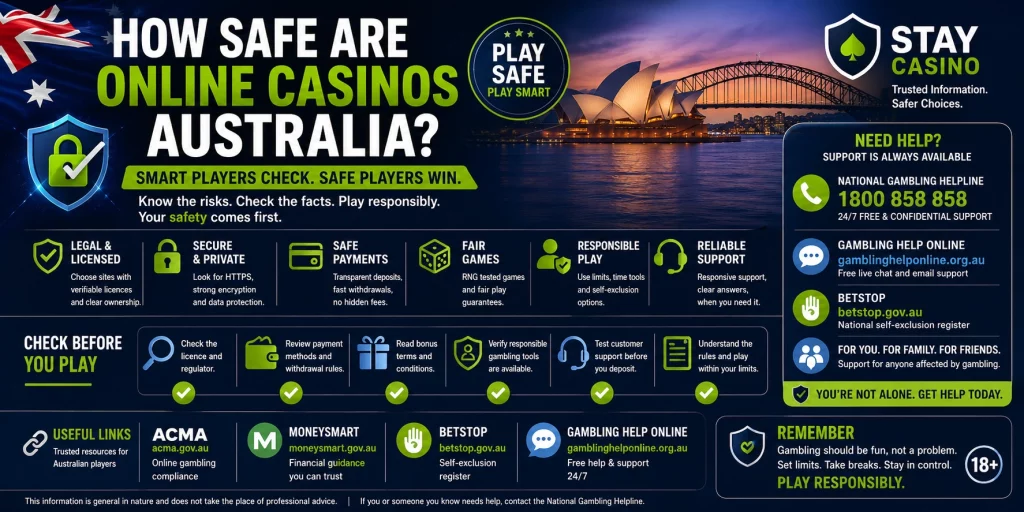
A safer approach begins with caution. Before using any online gambling-related platform, Australian users should check whether the service is properly licensed, whether it follows Australian consumer protection expectations, and whether it provides transparent responsible gambling tools.
What “Safe” Means for an Online Casino
Safety is not only about whether a website loads correctly or looks professional. A safe online gambling environment should protect the player in several ways.
First, legal safety matters. A platform should not operate in breach of Australian rules. Second, financial safety matters. Payments, withdrawals, identity checks, and account balances should be handled clearly. Third, data safety matters. A player’s personal information should be protected with secure systems. Fourth, game safety matters. Game outcomes should be independently tested and not manipulated. Fifth, responsible gambling safety matters. Players should have access to deposit limits, time limits, cooling-off periods, self-exclusion, and support information.
For Stay Casino readers, the safest reading of this topic is not “which casino should I choose?” but “what warning signs should I recognise before trusting a gambling website?”
Legal Status and Australian Consumer Protection
Australia has strict rules around interactive gambling. ACMA states that it can investigate and enforce the law where operators provide or advertise prohibited online gambling services. This includes action against unlicensed services and prohibited interactive gambling products.
This legal context matters because illegal or offshore operators may not provide the same consumer protections. A player may have fewer options if withdrawals are delayed, bonus terms are unclear, personal data is mishandled, or support refuses to resolve a dispute.
A professional-looking website is not enough. Logos, banners, fast registration forms, and promotional claims do not prove that a site is safe. Players should be cautious with any gambling site that avoids clear licensing details, hides ownership information, or makes unrealistic promises.
Account Access and Security
Account access is one of the first safety areas to check. A safe platform should protect the user’s account with secure passwords, encryption, identity verification, and clear account recovery processes.
Players should be careful when using a Login page on any gambling-related website. A secure page should use HTTPS, avoid suspicious redirects, and never ask for unnecessary personal information outside normal verification procedures.
Weak account security can create several risks. Personal details may be exposed, stored payment information may be misused, or the player may lose access to funds. Strong security systems reduce these risks.
Bonus Safety and Promotional Transparency
Promotions are one of the most common areas where players misunderstand risk. A large Bonus may look attractive, but safety depends on the terms behind it.
Players should check wagering requirements, maximum bet rules, withdrawal restrictions, country eligibility, time limits, game contribution percentages, and account verification conditions. If the terms are difficult to find or written unclearly, that is a warning sign.
A safe operator should explain promotional rules before the player accepts the offer. Promotions should not be used to pressure players into depositing quickly or gambling beyond their budget.
Registration and Verification Risks
The Sign up process should be transparent. A gambling website may ask for identity verification, age verification, address confirmation, and payment ownership checks. These checks are often part of compliance and fraud prevention.
However, players should be cautious if a platform accepts deposits easily but delays verification until withdrawal. This can create frustration when a person tries to access funds later.
A safer registration process explains verification requirements early. It also makes privacy policies, payment rules, and account terms easy to access before money is deposited.
| Safety Area | What to Check | Warning Sign |
|---|---|---|
| Legal status | Clear licensing and compliance information | No regulator listed or vague offshore claims |
| Account security | HTTPS, strong password tools, secure verification | Suspicious redirects or weak login protection |
| Bonus terms | Wagering rules, limits, expiry, withdrawal rules | Terms hidden or written unclearly |
| Payments | Transparent deposits, withdrawals, fees, timeframes | Unexplained delays or changing requirements |
| Responsible gambling | Limits, cooling-off, self-exclusion, support information | No clear harm-prevention tools |
Mobile Safety and Gambling Apps
Mobile access increases convenience but also increases risk. A gambling App can make it easier to deposit quickly, play for longer, or return during stress. This is why mobile safety should include both technical security and behavioural control.
Technically, players should avoid downloading apps from suspicious sources. Behaviourally, they should use time limits, spending limits, and notification controls. Push notifications and promotional reminders can become triggers for people who are trying to control gambling.
If gambling begins to feel difficult to stop, deleting the app and using blocking tools is safer than relying on willpower alone.
Game Safety and Fairness
Game safety depends on transparent rules, tested outcomes, and clear return-to-player information where relevant. Players should understand that Slots and other gambling products are designed around chance and house advantage. A game can be technically fair while still being financially risky.
The same applies to broader casino Games. Fairness does not mean the player is likely to win. It means the product operates according to stated rules. Players should never treat online casino games as a reliable way to make money.
Support Pages and Safer Gambling Information
A safer gambling website should make support information easy to find. The FAQ section should explain limits, withdrawals, account closure, verification, self-exclusion, and responsible gambling tools.
Reliable external Links should point users toward recognised support and regulatory resources, not only promotional pages. In Australia, BetStop is a free government initiative that lets people block themselves from licensed Australian online and phone gambling providers, and registered providers cannot let excluded people place bets, open new betting accounts, or receive marketing messages.
Why Payments Are a Major Safety Test
Payment safety is one of the clearest ways to judge whether an online casino environment is reliable. A site may look professional, promote large offers, and display polished branding, but payment handling reveals how seriously it treats player protection.
For Australian players, payment safety should include transparent deposit rules, clear withdrawal procedures, secure processing, visible fees, realistic timeframes, and consistent identity verification. If a gambling site makes deposits easy but withdrawals confusing, slow, or unpredictable, players should treat that as a serious warning sign.
A safe operator should explain payment conditions before a player deposits. This includes minimum deposit amounts, maximum withdrawal limits, document requirements, processing times, rejected withdrawal reasons, and any fees linked to payment methods.
Why Verification Should Be Clear Early
Identity verification is common in regulated gambling environments. It may be used to confirm age, identity, address, payment ownership, and fraud prevention requirements. Verification itself is not a problem. The problem appears when the process is unclear, inconsistent, or delayed until the player requests a withdrawal.
A safer website explains verification requirements before major payment activity begins. Players should know what documents may be required and how long the review may take.
If a site repeatedly requests new documents without clear explanation, changes requirements after a withdrawal request, or provides vague support responses, this may indicate weak operational standards.
Withdrawal Red Flags Players Should Notice
Withdrawal reliability is a major part of online casino safety. Players should look carefully at withdrawal terms before depositing money.
Common warning signs include unclear processing times, unrealistic withdrawal limits, hidden fees, repeated pending periods, vague verification requests, and support responses that do not explain the delay.
A platform that cannot clearly explain how withdrawals work should not be trusted with additional deposits.
| Payment Safety Check | Safe Practice | Warning Sign |
|---|---|---|
| Deposit rules | Clear minimums, limits, and accepted methods | Missing fee or limit information |
| Withdrawal timing | Published processing windows | Repeated unexplained delays |
| Verification | Requirements explained before withdrawal | New demands after every request |
| Fees | Transparent charges listed in advance | Unexpected deductions |
| Support response | Specific answers with clear timelines | Generic replies without resolution |
Data Protection and Personal Information
Online casino safety also depends on how personal information is handled. Gambling websites may collect names, addresses, dates of birth, identity documents, payment details, device data, and transaction history.
Because this information is sensitive, players should check whether the website provides a privacy policy, encryption, secure forms, and clear data handling rules. A platform that asks for personal documents without explaining privacy protection should be avoided.
Players should also use strong unique passwords and avoid reusing passwords from email, banking, or social media accounts. If two-factor authentication is available, it should be enabled.
Customer Support as a Safety Indicator
Customer support quality reveals a lot about a gambling platform. Safe operators provide clear, professional, and consistent answers. They do not avoid direct questions about withdrawals, bonus terms, verification, self-exclusion, or account closure.
Before depositing, players can test support by asking simple questions. How long do withdrawals take? What documents are required? How do deposit limits work? How can an account be closed? Where are responsible gambling tools located?
If support cannot answer basic safety questions, the platform is not reliable enough for serious trust.
Independent Reviews and Complaint Patterns
Player reviews should be interpreted carefully. One complaint may reflect an individual misunderstanding, but repeated patterns matter. If many users report delayed withdrawals, unclear bonus rules, locked accounts, poor verification handling, or ignored support requests, that pattern should be taken seriously.
Independent review sites, regulator notices, gambling forums, and complaint histories can help identify recurring risks. Players should not rely only on promotional content or affiliate rankings.
A safe evaluation includes both official information and user feedback trends.
Comparing Safety Layers
Responsible Gambling Tools as a Safety Requirement
A safe online casino environment should include practical responsible gambling tools. These may include deposit limits, time reminders, cooling-off periods, reality checks, self-exclusion, account closure, and support service information.
These tools should be easy to find and simple to activate. If a site hides responsible gambling settings, delays account closure, or makes self-exclusion difficult, that is a serious safety concern.
Responsible gambling tools are not decoration. They are part of player protection.
Why Licensing Is the First Safety Filter
Licensing is one of the most important safety checks for any online gambling platform. A licence does not guarantee that every player will have a good experience, but it shows that the operator is expected to follow rules, maintain standards, and respond to regulatory requirements.
For Australian players, regulation is especially important because not every online casino-style website available on the internet is legally permitted to target Australians. Some offshore platforms may continue to appear through search engines, advertisements, mirror domains, or affiliate pages, even when they create consumer protection concerns.
A player should never assume that a site is safe only because it accepts registrations. A proper safety review should begin with ownership details, licensing information, regulator visibility, complaint history, and responsible gambling standards.
What a Licence Should Tell Players
A legitimate licence should identify the operator, jurisdiction, regulatory body, and operating conditions. This information should be easy to locate, usually in the footer, terms and conditions, or licensing section of the website.
If the licence details are vague, missing, outdated, or impossible to verify, that is a warning sign. Some unsafe sites use impressive-looking badges that do not link to real regulatory information.
Players should also check whether the licence actually covers the product being offered. A licence for one type of gambling activity may not automatically authorise all casino-style products in every country.
Regulator Warnings and Blocked Websites
Australian players should pay attention to regulator warnings. ACMA regularly takes action against illegal online gambling services and may request blocking of prohibited websites. These actions show that unsafe or non-compliant operators can still attempt to reach Australian users.
Before trusting an unfamiliar online casino, players should look for regulatory notices, blocked-site lists, and complaint records. A site that has been named by a regulator should be treated with extreme caution.
This is especially important when a platform uses aggressive promotions, unusual payment methods, or unclear ownership details.
| Regulatory Check | What Safe Players Should Look For | Risk if Missing |
|---|---|---|
| Operator name | Clear company identity and ownership details | Difficult dispute resolution |
| Licence number | Verifiable licensing information | Possible unlicensed operation |
| Regulator link | Official regulatory reference or register | Fake badge or misleading claim |
| Terms and conditions | Clear rules for payments, bonuses, and accounts | Unexpected restrictions or disputes |
| Responsible gambling section | Limits, self-exclusion, support contacts | Weak player protection |
Game Fairness and Testing Standards
Game fairness is another major safety area. A safe online gambling environment should use games that are tested for random outcomes, correct payout calculations, and transparent rules.
Independent testing laboratories may audit random number generators, return-to-player calculations, and game performance. Players should look for information about testing bodies and fairness certification where available.
However, fairness should not be misunderstood. A fair game can still produce losses. Fairness means the game operates according to its stated mechanics, not that the player has a realistic income opportunity.
Return to Player and Volatility
Return to player, often shortened to RTP, is a theoretical long-term percentage that describes how much a game may return to players over a very large number of plays. It does not predict short-term results.
Volatility describes how often and how strongly wins may occur. A high-volatility game may produce long losing periods with occasional larger wins. A low-volatility game may produce smaller, more frequent outcomes.
Understanding RTP and volatility can help players understand risk, but these numbers do not remove the house advantage. Any gambling product can still result in losses.
Safer Gambling Tools and Behavioural Monitoring
Modern safer gambling systems may include deposit limits, session reminders, spending alerts, cooling-off periods, and self-exclusion features. Some platforms may also monitor behaviour for unusual patterns, such as rapid deposits or sudden increases in session length.
These tools are valuable because they help identify risk before serious harm develops. A safer platform should make them visible and easy to activate.
If a gambling site hides limit tools or makes account closure difficult, that is a poor safety signal.
Why Responsible Gambling Information Must Be Clear
Responsible gambling information should not be hidden at the bottom of a page in tiny text. It should be visible, practical, and direct.
Players should be able to find information about setting limits, taking breaks, closing accounts, using self-exclusion, and contacting gambling support. These tools should be accessible before gambling begins, not only after problems appear.
A strong responsible gambling section indicates that the operator recognises player protection as part of the service.
Reading Terms Before Depositing
Terms and conditions are not exciting, but they are essential. Many disputes happen because players do not read rules before depositing.
Important sections include bonus rules, account verification, withdrawal limits, maximum bets, restricted games, inactive account fees, document requirements, and dispute procedures.
If terms are vague, overly complex, contradictory, or frequently changed without clear notice, players should be cautious.
Why a Checklist Is Better Than Guesswork
Online casino safety should never depend on guesswork. A player should not trust a gambling website only because it has modern design, fast loading pages, colourful banners, or generous promotions. A proper safety decision should be based on visible evidence.
A practical checklist helps Australian players review the most important areas before creating an account, depositing money, accepting promotions, or sharing identity documents. This is especially important because some unsafe or non-compliant operators may still look professional on the surface.
The safest approach is simple: if key safety information is missing, unclear, or difficult to verify, the platform should be avoided.
Check Legal Status First
Legal status should always be the first filter. Players should look for clear licensing details, company ownership, regulator information, and compliance statements. If a site cannot explain who operates it or under which authority it functions, that is a serious warning sign.
Australian players should also be cautious with sites that appear to target them while avoiding clear Australian compliance information. A website may be accessible from Australia, but accessibility does not automatically mean safety or legality.
Review Payments Before Depositing
Payments should be reviewed before any money is added. A safe website should explain deposit methods, withdrawal options, processing times, minimum and maximum withdrawal amounts, fees, verification requirements, and rejected withdrawal reasons.
Players should be especially careful with platforms that make deposits instant but withdrawals slow, unclear, or heavily restricted. Withdrawal transparency is one of the strongest indicators of operational reliability.
| Final Safety Check | Safe Standard | Unsafe Signal |
|---|---|---|
| Licensing | Clear, verifiable regulator information | No licence details or vague offshore claims |
| Payments | Transparent deposit and withdrawal rules | Hidden fees or unexplained delays |
| Security | HTTPS, privacy policy, secure verification | Poor data handling or suspicious redirects |
| Game fairness | Published rules, RTP information, testing references | No fairness or testing information |
| Responsible gambling | Limits, cooling-off, self-exclusion, support resources | Tools hidden or difficult to activate |
Protect Personal Data Carefully
Online gambling accounts may require sensitive information. This can include full name, date of birth, address, identity documents, payment details, and transaction records. Players should only share this information with platforms that explain how data is stored and protected.
A safe website should provide a clear privacy policy and secure submission process. Players should avoid sending documents through informal channels unless the process is clearly protected and officially explained.
Using strong passwords, avoiding shared devices, and enabling additional account protection where available can reduce account security risks.
Test Support Before Trusting the Platform
Customer support can reveal whether a platform is reliable. Before depositing, players can ask basic questions about withdrawals, verification, limits, self-exclusion, and account closure.
A safe support team should answer directly and consistently. Poor support, generic replies, long delays, or refusal to explain terms should be treated as warning signs.
Support quality becomes especially important when money is involved. If the platform cannot answer basic safety questions before a deposit, it may be even less helpful after a problem appears.
Keep Gambling Risk Separate From Platform Safety
Even a technically safe gambling platform still carries financial and behavioural risk. Licensing, encryption, and fair testing do not remove the possibility of losing money.
Players should understand the difference between platform safety and gambling safety. A platform may protect data and process payments correctly, but gambling can still become harmful if the player loses control, chases losses, or spends more than planned.
This is why responsible gambling tools remain essential even on better-regulated platforms.
When the Safest Choice Is Not to Play
The safest decision is not always choosing a different casino. Sometimes the safest decision is not gambling at all.
If gambling causes stress, debt, secrecy, repeated overspending, relationship conflict, or difficulty stopping, the player should step away and contact support. In Australia, gambling support services, self-exclusion tools, and financial counselling can help reduce harm.
No platform safety feature can replace personal control. Once gambling begins affecting money, mood, trust, or daily responsibilities, stopping is safer than continuing.
How Safe Are Online Casinos in Australia?
Online casinos in Australia can vary widely in safety. Some gambling environments may provide stronger security, clearer rules, reliable payments, and better responsible gambling features. Others may expose players to legal uncertainty, weak consumer protection, unclear withdrawals, aggressive promotions, or poor support.
The safest player is the one who checks before trusting. Legal status, licensing, payments, verification, support quality, game fairness, privacy protection, and responsible gambling tools should all be reviewed before any account activity.
For Australian users, caution is essential. If an online casino cannot prove that it operates transparently and responsibly, the risk is too high.
The final answer is clear: online casinos are only as safe as their regulation, transparency, payment reliability, data protection, fairness standards, and harm-prevention systems. If those elements are missing, players should avoid the site and choose safer, legal, and responsible alternatives.






Comments